Griffith Park: Los Angeles's Golf Commons Since 1914
Stand on the first tee at Wilson or Harding on a Saturday morning and you're in a line that stretches back more than a century — retirees, teenagers, studio grips off a night shoot, all waiting to play the same ground where PGA Tour champions once chased the Los Angeles Open. Griffith Park is where public golf in Los Angeles began: forty-five municipal holes inside the park today, plus the little Los Feliz 3-Par just beyond its eastern edge, on land whose donor insisted it be open to everyone. That ideal, as we'll see, took the sport itself decades to honor — but the starter's window has never required a membership.
A Park Born as a "Christmas Present"
The story starts before golf does. On December 16, 1896, Colonel Griffith J. Griffith and his wife donated 3,015 acres of the old Rancho Los Feliz to the City of Los Angeles — Griffith called it "a Christmas present." He was explicit about who the land was for, declaring that public parks should be "accessible and attractive, where neither race, creed nor color should be excluded," and that the park "must be made a place of rest and relaxation for the masses, a resort for the rank and file, for the plain people."
Griffith himself was a deeply flawed benefactor, and the history should be told straight: in 1903 he shot his wife Tina at the Arcadia Hotel in Santa Monica — she survived but lost her right eye — and he served time in San Quentin for assault with a deadly weapon. When he later offered the city money for a Greek theater and hall of science in 1912, park commissioners went to court to block the gift. Only after his death in 1919 did his estate fund two of the park's landmarks, the Greek Theatre (1929) and Griffith Observatory (1935).
Only the park's first golf course arrived while Griffith was still alive; every course a golfer can play today came after his death, built by a city slowly making good on the "plain people" promise.
1914: The Municipal Golf Links
Los Angeles municipal golf began in Griffith Park in 1914, when the city opened its original Municipal Golf Links on the flats along the Los Angeles River. City course histories credit the layout to Tom Bendelow, the Scottish-born architect whose name is on hundreds of early American courses. (The early naming is genuinely muddled — the city's own archived histories disagree about which of the park's early layouts carried the old "Riverside" name — so we won't pretend the record is cleaner than it is.) It was a modest beginning in a rough-and-ready corner of the park; a 180-acre aviation field operated nearby from 1912 to 1939, so early municipal golfers shared their landscape with airplanes.
Demand did what demand does in Los Angeles: it outgrew the supply almost immediately.
George C. Thomas Jr. Builds the City 36 Holes
Griffith Park's municipal courses share an architect with some of the most exclusive clubs in the country. George C. Thomas Jr. — who designed Riviera Country Club and Bel-Air Country Club and redesigned the North Course at Los Angeles Country Club — laid out 36 holes of Los Angeles Municipal golf in Griffith Park in 1923, working, as he so often did, alongside William P. Bell.
Harding: the first all-grass muni (1923)
The first of Thomas's courses opened in August 1923 as Griffith Park's first all-grass course — a real step up from the era's rougher municipal conditions. In 1924 it was renamed the Warren G. Harding Memorial Golf Course, for the president who had died in office in San Francisco the previous summer, beginning Griffith Park's tradition of naming its courses after American presidents. Today Harding plays 6,536 yards, tree-lined and tighter than it looks, with narrow approaches into guarded greens.
Wilson: the big course (1927)
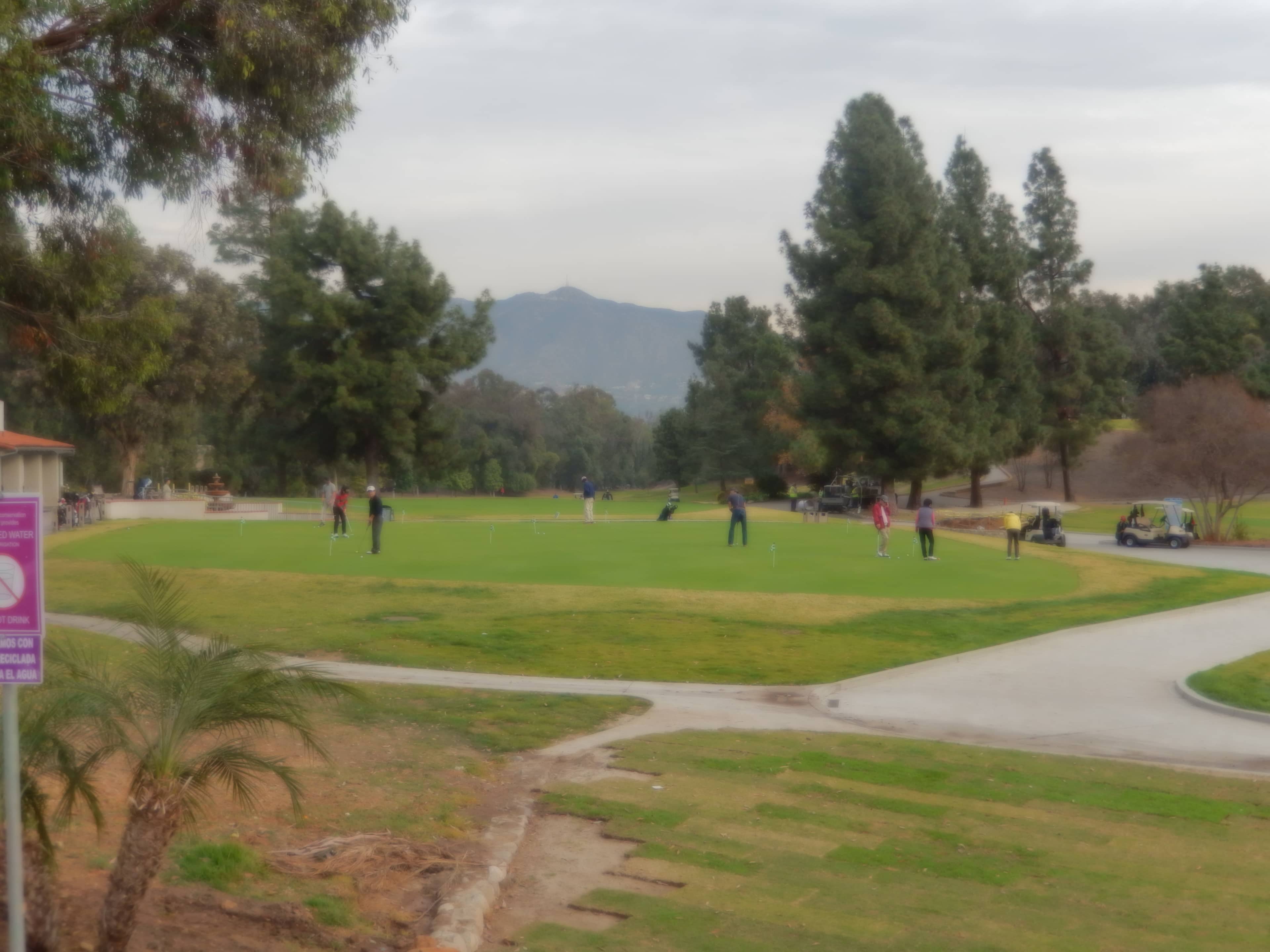
The companion course opened in 1927 as the park's third municipal course, replacing parts of Bendelow's original 1914 Municipal Golf Links, and was named for Woodrow Wilson, keeping the presidential theme. Wilson is the long one: 6,947 yards of wide fairways in a semi-forest setting at the park's edge. It hosted the L.A. City Championship for the first time in 1928 (Harding had held it first, in 1923), and the two courses have anchored the city's championship golf ever since.
Think about what that means for a public golfer: the architect of Riviera — a course that has ranked among America's very best — built a 36-hole complex you can play for a municipal green fee. Few cities in the world can offer that.
When the L.A. Open Came to the Park
The Los Angeles Open — today's Genesis Invitational — was founded in 1926 at Los Angeles Country Club, and in its early years it rotated through the city's great private clubs: Riviera, Wilshire, Hillcrest, El Caballero. Then, in the late 1930s, the tournament came to the public park. Exactly when is one of the record's small puzzles: the tournament's own history places the L.A. Open on Wilson from 1937 through 1939, with one round in each of the first two of those years played on the adjacent Harding, while the city's archived course histories say Wilson and Harding co-hosted the Opens of 1936 through 1938. The sources disagree on the bookends; what nobody disputes is that for a few years in the late 1930s, the biggest golf tournament in Los Angeles belonged to the muni crowd.
The winners were not fringe names. Tournament records list the 1937 title going to Harry Cooper — "Lighthorse Harry," so nicknamed by writer Damon Runyon after Cooper raced through the final 18 holes of the 1926 L.A. Open at Los Angeles Country Club in two and a half hours — a man who won 30 times on the PGA Tour. Jimmy Demaret, listed as the 1939 champion, would go on to become the first three-time winner of the Masters (1940, 1947, 1950) and collect 31 tour victories. And the 1938 edition at the park produced one of the most famous entries in tournament history, when Babe Didrikson Zaharias teed it up against the men.
Who Got to Play: The Promise and the Exclusion
Griffith's deed language — "neither race, creed nor color" — was an ideal, and for decades the sport around it fell badly short of it. The honest version of this history holds both facts at once: the public course was the most open door in Los Angeles golf, and golf itself was systematically closed. The PGA of America kept a Caucasian-only clause in its constitution until 1961 — a period that spans nearly the entire era described in this article.
In 1920, members of the city's Jewish community founded Hillcrest Country Club in Cheviot Hills precisely because Jewish Angelenos were systematically excluded from the city's other elite clubs. Hillcrest became a Hollywood institution — Louis B. Mayer and the Warner brothers were members, and by the 1940s its Friday "round table" lunches gathered Jack Benny, George Burns, the Marx Brothers, Danny Kaye, and Milton Berle. That the club exists at all is documented testimony to who was being kept out elsewhere.
Public courses were the other answer. Municipal golf was where you played when no club would have you, and Los Angeles's munis became proving grounds for golfers the private game shut out. The arc runs through the tournament Griffith Park once hosted: in 1969, Charlie Sifford — the Black golfer who broke the PGA's color line — won the Los Angeles Open in a playoff over Harold Henning. That victory came across town at Rancho Park Golf Course, the West L.A. muni that hosted the Open for most of that era — not at Griffith Park — but it completes the story: the tournament the park helped sustain in the 1930s became, three decades later and on another public course, the site of one of golf's landmark victories for integration. The event now grants a Charlie Sifford Memorial Exemption in his honor.
The Zoo, the Freeway, and the Modern Map
The original 1914 links did not survive intact. Its last nine holes lived on as the old Roosevelt course until the relocation of the Los Angeles Zoo claimed the ground; a new Roosevelt Municipal Golf Course — nine holes tucked below the Griffith Observatory, near the Greek Theatre — opened in 1964 to replace it. And on Los Feliz Boulevard, just east of the 5 and just beyond the park proper, sits the smallest member of the family: the Los Feliz 3-Par, nine holes, 1,043 yards, par 27. If it looks familiar, that's because it was featured in the film Swingers, which made a tiny muni par-3 briefly the most famous golf course in independent cinema.
That's the modern map: Wilson and Harding sharing a clubhouse on Crystal Springs Drive, Roosevelt on the hill, Los Feliz on the boulevard — forty-five holes inside the park and nine more next door, with the city's junior program, the Tregnan Golf Academy, keeping the pipeline open for the next generation of L.A. public golfers.
Playing the History Today
A practical note for the golf historian with a tee time. Play Wilson if you want the championship scale — nearly 7,000 yards on the same corridors that hosted the L.A. Open. Play Harding for the older bones: the August 1923 original, Thomas's first all-grass muni, where accuracy still beats muscle. Take Roosevelt at golden hour, when the Observatory glows on the ridge above, and finish an evening at Los Feliz with a putter and a wedge.
More than a hundred years after the first municipal links opened by the river, Griffith Park golf remains the closest thing Los Angeles has to what its donor described: accessible, attractive, and — at the starter's window, if not always in the sport's history — open to everyone. In a city where so much golf history lives behind gates, the park's version has a green fee. For the full sweep of that story, from sand greens to the Genesis Invitational, see our history of golf in Los Angeles.

