Babe Didrikson Zaharias and the 1938 Los Angeles Open
In January 1938, a 26-year-old two-time Olympic gold medalist filed an entry for the Los Angeles Open, a marquee stop on professional golf's West Coast swing, played that year at Griffith Park — a Los Angeles municipal golf facility. Nothing in the rules said a woman couldn't play. So Mildred "Babe" Didrikson entered, was admitted into the field, and became the first woman ever to tee it up in a men's professional golf tournament.
She missed the cut. She also met her future husband in her own threesome, launched a chain of events that would remake women's golf, and gave Los Angeles's public golf a founding chapter in the story it keeps telling: this is the city where the game's closed doors get tested in the open, on courses anyone can play.
A Texan Made by Los Angeles
Babe Didrikson was not an Angeleno — she was born Mildred Ella Didrikson on June 26, 1911, in Port Arthur, Texas, and lived in Southern California for only a few months of her life. But it is hard to name a city that shaped her more. Los Angeles is where she became world-famous, where she got serious about golf, and where she twice made golf history.
The fame came first. At the 1932 Olympic Games in Los Angeles, Didrikson won gold in the javelin and gold in the 80-meter hurdles — lowering her own world record to 11.7 seconds in the final — and took silver in the high jump after clearing the same height as the winner, only to be ruled out on a technicality over her jumping technique. Three events, three medals.
Golf — at least in the version of the story Southern California likes best — came just days later, through the press box. As the tale is told, Grantland Rice, America's leading sportswriter, took Didrikson to play at Brentwood Country Club on LA's Westside during those same 1932 Games, and she caught the bug for good. Some biographies have her swinging a club back in Texas even earlier, so the Brentwood origin deserves a grain of salt — but what came next tied her game to the city either way: she spent the spring and summer of 1933 in California taking lessons from Stan Kertes, a top Los Angeles–area professional who molded her game for free. However the origin story is told, one of the towering careers in women's golf was built in no small part on LA lesson tees.
There was a catch. After Didrikson won the 1935 Texas Women's Amateur, golf's establishment denied her amateur status — she had earned money as an athlete in other sports — which shut her out of virtually all women's competition of consequence. The women's professional circuit barely existed. By January 1938 she was a professional golfer with almost nowhere to play.
So she looked at the biggest tournament in town and asked the only question that mattered: where does it say I can't?
The 1938 Los Angeles Open: The First Woman in a PGA Tour Field
The Los Angeles Open was already the marquee event of West Coast golf. Founded in 1926 at Los Angeles Country Club with a $10,000 purse — then the richest in professional golf — it had moved among the city's great venues and, from 1937 to 1939, set up at Griffith Park, the heart of LA's municipal system. The George C. Thomas Jr.–designed Wilson Course was the primary stage, though one round of each of the first two editions — 1938 included — was played on the adjacent Harding Course.
That municipal setting mattered. A private club could have found a way to say no. The LA Open at Griffith Park, with no qualifying barrier that year and no rule barring women, simply processed her entry. Didrikson was in the field — the first woman to play in a PGA Tour event, a distinction no one had thought to legislate against because no one had imagined anyone would try.
The wrestler and the minister
The pairing sheet for her first two rounds read like a setup for a vaudeville act: Babe Didrikson, Olympic champion; George Zaharias, a 300-pound professional wrestler billed as "The Crying Greek from Cripple Creek" and one of the ring's great villains; and C. Pardee Erdman, a Presbyterian minister and Occidental College professor. Zaharias, born Theodore Vetoyanis in Pueblo, Colorado, in 1908, reportedly grumbled about being paired with a woman — right up until they started playing.
By most accounts the two spent the rounds flirting, mugging for photographers, and having a far better time than Didrikson's scorecard did. She shot an 84 and an 81 — accounts differ on which came first — and missed the cut; Jimmy Thomson went on to win the tournament. Eleven months later, on December 23, 1938, Babe Didrikson and George Zaharias were married in St. Louis. He soon gave up wrestling to manage her career. She would compete as Babe Didrikson Zaharias for the rest of her life. Whatever the 1938 Los Angeles Open cost her in strokes, it paid her back in full.
1945 at Riviera: The Cut Heard Round the World
Zaharias wasn't finished with the LA Open — and her second act was better than her first.
By January 1945 the tournament had settled at Riviera Country Club, the Thomas masterpiece in Pacific Palisades that would later become its permanent home. This time there was qualifying, and Zaharias earned her place the hard way, shooting 76-76 to get into the field. In the tournament proper she opened with another 76, added a second-round 81, and made the 36-hole cut — the first woman ever to make a cut in a PGA Tour event. A third-round 79 left her outside the 54-hole cut line at an event won by Sam Snead, who edged Byron Nelson and Jug McSpaden by a single stroke at 283.
She kept going. That same month she played the Phoenix Open and the Tucson Open, making the initial cut in all three of her January 1945 PGA Tour starts — she finished 33rd at Phoenix and tied for 42nd at Tucson. More than eighty years later, she remains the only woman ever to make the cut in a regular PGA Tour event. Annika Sörenstam, Michelle Wie and others have since taken up men's-tour invitations; none has matched what Zaharias did at Riviera in 1945.
What Came After: From LA's Fairways to the LPGA
The Los Angeles chapters bookend the astonishing rest of it. Zaharias regained her amateur status in 1943 after sitting out the required waiting period, then went on the tear that made her case as the greatest women's golfer of her era: the 1946 U.S. Women's Amateur, and in 1947 the British Ladies Amateur — the first American ever to win it. She turned professional again and in 1950 became a founding member of the Ladies Professional Golf Association, the tour whose existence owes as much to her celebrity as to any single force.
Across her amateur and professional career she won 82 tournaments, including ten major championships and three U.S. Women's Opens (1948, 1950 and 1954). The last was the most remarkable: after undergoing cancer surgery in April 1953, she came back to win the 1954 U.S. Women's Open roughly fifteen months later — by twelve strokes, while wearing a colostomy bag. The disease returned, and she died on September 27, 1956, at 45 — an athlete the Associated Press had repeatedly named the greatest woman athlete of the half-century, whose golf story, as Los Angeles tells it, began with a sportswriter's invitation to an LA country club.
Why Griffith Park Was the Perfect Stage
It is not an accident that this happened in Los Angeles, and not an accident that it happened on a municipal course. As we argue in our full history of golf in Los Angeles, LA built golf's biggest stage — the richest purse in the game at the first LA Open in 1926, and a century of spotlight moments since. But the city's other signature is access: its enormous public golf system kept producing the moments when the game's barriers cracked in front of paying galleries.
Zaharias at Griffith Park in 1938 is the first of those moments. Thirty-one years later, Charlie Sifford — who had broken the PGA's color line — won the 1969 Los Angeles Open at municipal Rancho Park, and Maggie Hathaway's activism eventually put an African American woman's name on an LA County course. The gender line and the color line were both tested at the LA Open, on public ground, decades before either fell anywhere else. The tournament that admitted Babe Didrikson in 1938 lives on today as the Genesis Invitational at Riviera, which marked the lineage's centennial in 2026.
You can still play both of Babe's LA Open courses. Griffith Park's Wilson Course remains one of the anchors of the city's municipal system, and Riviera Country Club — private, but golf's most public private club — hosts the tour every winter, welcomes the world for the LA28 Olympic golf competition, and stages the 2031 U.S. Open.
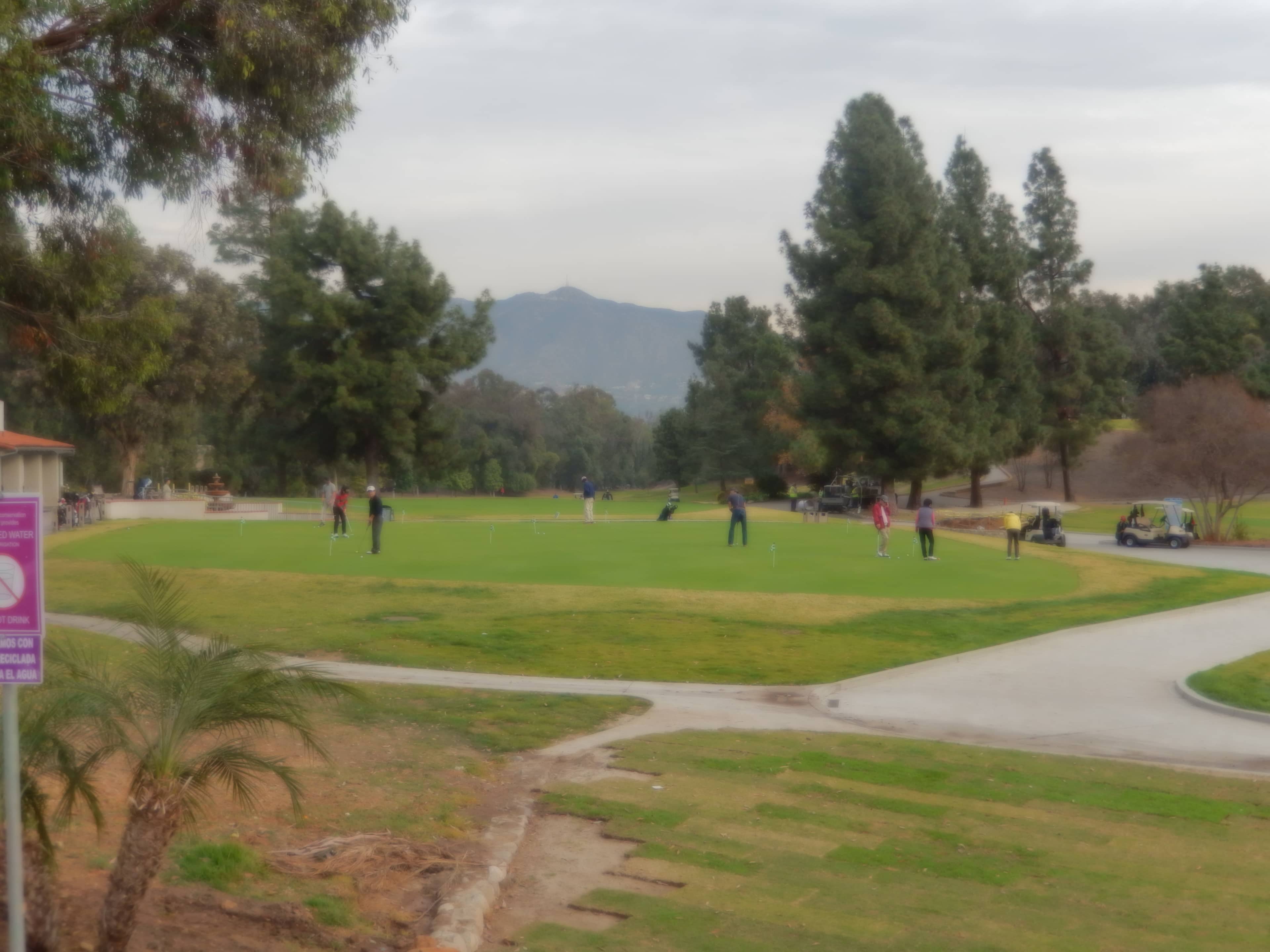
Babe Zaharias's Los Angeles, at a glance
1932 — Wins two golds (javelin; 80-meter hurdles, world record) and a silver (high jump) at the Los Angeles Olympics — and, by one enduring account, plays a catalytic round at Brentwood Country Club at Grantland Rice's invitation.
1933 — Spends spring and summer in California taking free lessons from LA professional Stan Kertes.
January 1938 — Enters the Los Angeles Open at Griffith Park: the first woman in a PGA Tour field. Shoots 84 and 81, misses the cut, meets George Zaharias in her pairing; they marry that December.
January 1945 — Qualifies for the LA Open at Riviera with 76-76, then makes the 36-hole cut with 76-81. Still the only woman ever to make a cut in a regular PGA Tour event.
Legacy — 82 career wins, ten majors, LPGA founder; a member of the Southern California Golf Hall of Fame for the history she made on LA's courses.
This profile is part of our series on the history of golf in Los Angeles. Read the full LA golf history, or continue with the stories of Ben Hogan at Riviera and Charlie Sifford's 1969 LA Open win at Rancho Park.


