The Most Influential Figures in Los Angeles Golf
Ask for famous golfers from Los Angeles and you run into a beautiful irony: almost none of the people who defined LA golf were born here. Ben Hogan and Babe Didrikson Zaharias were Texans. Charlie Sifford came from North Carolina, Maggie Hathaway from Louisiana, William P. Bell from Pennsylvania. Even Tiger Woods grew up in Cypress, across the Orange County line. What Los Angeles gave every one of them was the stage — some of the richest purses of the era, courses celebrated nationwide, and the public fairways where golf's color line and gender line both cracked. These are the Los Angeles golf legends: not natives, but figures whose defining moments happened here, and who left the city's golf landscape permanently changed.
The Architects Who Built the Stage
George C. Thomas Jr.
Every list of influential LA golf figures starts with George C. Thomas Jr. (1873–1932), a Philadelphia millionaire who arrived in Southern California in the early 1920s and, in a single decade, drew the blueprints for the city's golf golden age: the two municipal 18-hole courses at Griffith Park (1923), Bel-Air Country Club (1926), Riviera Country Club (opened in 1926, though some accounts date it to 1927), and the celebrated redesign of the Los Angeles Country Club's North Course (1927–28) — the layout that hosted the 2023 U.S. Open, the first played in Los Angeles since 1948, and one that is widely regarded among the West Coast's great strategic designs. Thomas literally wrote the book on his craft, Golf Architecture in America, arguing that a course without individuality "lacks the great assets of originality and diversity." He spent his final years breeding roses in Beverly Hills, where he died in 1932. His three masterpieces — Riviera, Bel-Air, LACC North — are still ranked among America's best courses a century later.
William P. Bell
Behind nearly every Thomas design stood a fellow Pennsylvanian with dirt under his fingernails. William P. Bell (1886–1953), born in Canonsburg and transplanted to Pasadena, was Thomas's builder and collaborator at Riviera and Bel-Air, and though Thomas held the title of architect, Bell made significant contributions to the designs themselves. On his own, Bell built the 36 holes at Brookside in Pasadena and dozens of courses across the Southwest. One caution for anyone tracing his work: there are two Bells. William P. Bell's son, William Francis Bell (1918–1984), trained under his father, joined the practice as a partner after World War II, and became a major architect in his own right — many mid-century Southern California courses belong to the son, not the father. Between the two of them, the Bell family shaped an enormous share of Southern California's fairways.
The Champions Who Made LA Golf Famous
Ben Hogan
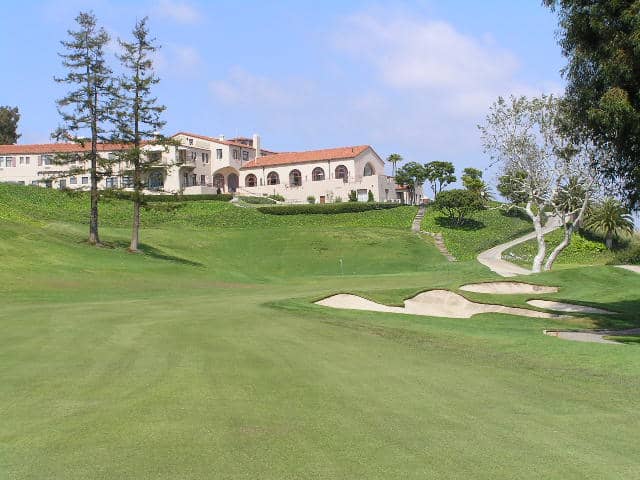
No player is more tightly bound to a single LA course than Ben Hogan is to Riviera. The Texan won the Los Angeles Open there in 1947 and again in 1948, then returned that June and won the 1948 U.S. Open on the same fairways, shattering the championship scoring record with a total of 276. Sportswriters started calling Riviera "Hogan's Alley," and the nickname has never come off. Riviera was also the site of one of sport's great comebacks: eleven months after the 1949 head-on collision with a Greyhound bus that nearly killed him, Hogan teed it up at the 1950 Los Angeles Open, posted 4-under 280, and lost only in a playoff to Sam Snead. Los Angeles didn't make Hogan a champion — but it named the place where his legend lives.
Babe Didrikson Zaharias
Babe Didrikson announced herself to Los Angeles at the 1932 Olympic Games, winning two gold medals and a silver in track and field. Six years later she made history on an LA golf course: at the 1938 Los Angeles Open she became the first woman to compete in a men's PGA Tour event. She shot 81–84 and missed the cut — but she was paired that week with a professional wrestler named George Zaharias, and married him that December. The LA Open gave her both a landmark and a last name. She wasn't done with the tournament, either: in January 1945 she qualified for the Los Angeles Open, made the two-day cut, and made cuts in three PGA tournaments that year — still the only woman ever to do so. The Port Arthur, Texas native went on to co-found the LPGA, but the door she kicked open first was in Los Angeles.
The Barrier Breakers
Golf's segregation didn't end in a courtroom back east — much of it ended on Los Angeles municipal courses. Bill Spiller, a railroad porter who learned competitive golf in 1940s LA, sued the PGA of America with Ted Rhodes in 1948 after being excluded from tournament fields under the "Caucasian-only" clause. In 1952, PGA president Horton Smith moved to bar Spiller and boxing champion Joe Louis from the San Diego Open, and the outcry went national. Louis, an amateur, was ultimately allowed to play on a sponsor's exemption — but Spiller, a professional, remained shut out, a contrast that laid the injustice bare. Sustained pressure, capped by California Attorney General Stanley Mosk's 1960 threat to bar the PGA from public courses, forced the organization to strike the clause in November 1961.
Charlie Sifford
The man who walked through the door Spiller pried open was Charlie Sifford. Born in Charlotte, North Carolina in 1922, Sifford became the first African American member of the PGA Tour in 1961 and its first Black winner at Hartford in 1967. His crowning moment came in Los Angeles: at the 1969 Los Angeles Open, on the city-owned fairways of Rancho Park, the 46-year-old beat Harold Henning with a birdie on the first playoff hole. A Black champion, at a public course, in the tournament that is now the Genesis Invitational — it remains one of the most meaningful wins in tour history. Sifford became the first African American inducted into the World Golf Hall of Fame in 2004 and received the Presidential Medal of Freedom in 2014.

Maggie Hathaway
Maggie Hathaway (1911–2001) never played the tour, and she belongs on this list anyway. A Louisiana-born blues singer, actress, and sportswriter, Hathaway took up golf in 1955 on a wager with Joe Louis and turned the game into a civil-rights front. She agitated against courses that restricted Black players, founded the Minority Association for Golfers in 1960 to support young Black golfers, picketed Long Beach's municipal course over discriminatory hiring in 1963, co-founded the Beverly Hills/Hollywood NAACP branch, and helped establish the NAACP Image Awards in 1967. In 1997, Los Angeles County renamed the Jack Thompson par-3 in South LA the Maggie Hathaway Golf Course in her honor. In March 2026 that little nine-hole par-3 reopened after a roughly $20 million renewal — $7.8 million from LA County and $12 million in private donations — with the renovation work led by Gil Hanse, the architect of the Rio Olympic course. Ahead of the LA28 Games, the course named for golf's most relentless activist is the city's newest stage.
LA's Own: The Modern Legends
Amy Alcott
If the cluster has a true Angeleno, it's Amy Alcott. Born in Kansas City in 1956 but raised in Pacific Palisades, Alcott graduated from Palisades High School, turned professional at 18, and built a World Golf Hall of Fame career: 29 LPGA Tour victories and five major championships, including the 1980 U.S. Women's Open and three Nabisco Dinah Shore titles. It was Alcott who, after her 1988 Dinah Shore win, started the tradition of champions leaping into Poppie's Pond. Inducted into the Hall of Fame in 1999, she has never really left LA golf: she lives in Santa Monica, coached the girls' golf team at Harvard-Westlake School, and served on the design team for the Rio 2016 Olympic golf course — the first Olympic golf venue in more than a century — alongside Gil Hanse.
Tiger Woods
Tiger Woods is not from Los Angeles — he was born and raised in Cypress, in Orange County — but his professional story begins here. In 1992, a 16-year-old high school sophomore accepted a sponsor's exemption into the Nissan Los Angeles Open at Riviera, making his first start in a PGA Tour event. He shot 72–75 and missed the cut by six. What followed is one of golf's strangest streaks: the winner of 82 PGA Tour titles and 15 majors has never won at Riviera — a distinction he shares, remarkably, with Jack Nicklaus. Woods's relationship with the tournament changed in 2020, when it became the Genesis Invitational, an elevated invitational event run by his foundation. The kid who debuted there now hosts the show.
The Supporting Cast
A few more names thread through every era of LA golf. Harry Cooper won the very first Los Angeles Open in 1926 at the Los Angeles Country Club, launching the tournament that has run for a century; since 1973 Riviera has hosted it in all but a handful of years — 1983 (played at Rancho Park), 1998 (Valencia), and 2025, when the January wildfires moved the event to Torrey Pines. Jack Nicklaus chose the 1962 LA Open at Rancho Park for his professional debut, finished tied for 50th, and cashed a check for $33.33. And Hollywood kept the game glamorous: Bing Crosby, a two-handicap and five-time club champion at Lakeside Golf Club, founded the pro-am that became the AT&T Pebble Beach Pro-Am, while Bob Hope — a four-handicap who played in as many as 150 charity tournaments a year — became the face of the desert event founded in 1960 as the Palm Springs Golf Classic, lending it his name and taking over as host when it became the Bob Hope Desert Classic in 1965.
Where to Walk in Their Footsteps
The best part of LA's golf history is how much of it is public. You can play Rancho Park, where Sifford won and Nicklaus debuted; the Griffith Park courses that George Thomas touched in 1923; and the reborn Maggie Hathaway Golf Course in South LA. Riviera — Hogan's Alley, Tiger's near-miss, and Thomas and Bell's masterpiece — hosts the Genesis Invitational every February, welcomes the world for the 2028 Olympic golf competition, and stages the U.S. Open in 2031. A hundred years after Harry Cooper won the first LA Open, the stage these figures built keeps getting bigger.


