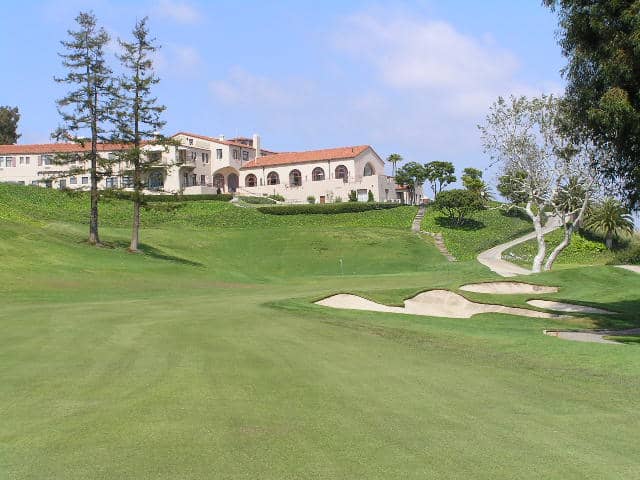
Ben Hogan: Why Riviera Is Called Hogan's Alley
Stand on the bluff above Riviera Country Club's first tee in Pacific Palisades and you're looking down into a canyon with two names. The scorecard says Riviera. Golfers say Hogan's Alley.
The nickname is one of the most repeated in golf — you'll hear it every February when the Genesis Invitational comes to town — but the story behind it is very specific: one Texan, one Los Angeles course, and eighteen months of golf so good that sportswriters renamed the place while he was still playing it.
Why Is Riviera Called Hogan's Alley? The Short Answer
Riviera is called Hogan's Alley because Ben Hogan won three tournaments there in less than eighteen months: the 1947 Los Angeles Open, the 1948 Los Angeles Open, and the 1948 U.S. Open — the first U.S. Open ever played on the West Coast. Across those three events he was a combined 21 under par on a course that was already regarded as one of the hardest tests in American golf. By the time Hogan completed the run, sportswriters were calling the course Hogan's Alley, and the name never left.
Two years later, Hogan gave the nickname a second, deeper meaning: Riviera is where he returned to competition after the 1949 car crash that nearly killed him. The alley was his coming and his coming back.
The Course Came First
Hogan didn't make Riviera; he certified it. The course was commissioned by the Los Angeles Athletic Club and designed by George C. Thomas Jr. — the Philadelphia-born amateur architect who reportedly took no fee for his design work, and who also shaped Bel-Air and the Los Angeles Country Club's North Course — with his construction partner William P. Bell. It opened in 1926 at a cost of $243,827, an almost scandalous sum for a golf course of that era.
Riviera arrived just as Los Angeles was becoming one of professional golf's biggest stages. The first Los Angeles Open had been played that same year, 1926, at the Los Angeles Country Club, carrying a $10,000 purse — one of the richest in professional golf at the time — and the young tournament rotated through the city's courses before finding the venue that would eventually become its permanent home. When the LA Open came to Thomas and Bell's canyon course, it found the perfect stage. It only needed a lead actor.
Three Wins in Eighteen Months
Ben Hogan was not an Angeleno — he was born in Stephenville, Texas, in 1912, and remained a Texan his whole life. Los Angeles was something else to him: the place where his legend was staged. He already had history with the LA Open, having won it in 1942 at Hillcrest Country Club. Then came the run.
January 1947: The First Riviera Title
Hogan won the 1947 Los Angeles Open at Riviera at 280, four under par. It was the win that started the pattern: precise, controlled golf on a course that punished anything less.
January 1948: The Record
A year later Hogan returned and won the LA Open again — this time at 275, nine under par, a tournament scoring record on a course nobody was supposed to take apart. He had now won back-to-back LA Opens on the same course, and the season's biggest championship was about to come to the same fairways.
June 1948: The U.S. Open Comes West
The 1948 U.S. Open, played June 10–12 at Riviera, was the first U.S. Open held on the West Coast — the national championship's belated acknowledgment that American golf's center of gravity had spread to Los Angeles. Hogan shot 67-72-68-69 for a 276 total, eight under par, beating Jimmy Demaret by two and demolishing the U.S. Open scoring record — Ralph Guldahl's 281 from 1937 — by five strokes. He collected $2,000 from a $10,000 purse, and having won the PGA Championship weeks earlier, he became just the second player to win both majors in the same year.
The numbers aged remarkably well. Hogan's 276 stood as the U.S. Open record for 19 years, until Jack Nicklaus edged it by a single stroke in 1967. His eight-under-par mark lasted even longer — no U.S. Open champion went lower relative to par until Tiger Woods shot 12 under at Pebble Beach in 2000, more than half a century later.
Three wins on one course in eighteen months, 21 under par in aggregate. The nickname wasn't hype; it was arithmetic.
One Nickname, Two Courses
A note for the trivia-minded: Riviera shares the "Hogan's Alley" nickname with Colonial Country Club in Fort Worth, Texas, where Hogan won five times and which sits in his home state. Both claims are legitimate — Hogan was simply good enough to have an alley on each end of the country. But Riviera's version carries the part of the story Colonial can't: the comeback.
February 1949: The Crash
On February 2, 1949 — one year almost to the day after his second Riviera LA Open — Hogan's Cadillac collided head-on with a Greyhound bus on a fog-shrouded highway near Van Horn, Texas. He suffered a fractured collarbone, ankle, pelvis and rib, along with internal injuries. There was real doubt he would walk normally again, let alone play tournament golf.
January 1950: The Comeback at Hogan's Alley
Eleven months later, Hogan chose Riviera for his return. His first tournament back was the 1950 Los Angeles Open, played on the course that already bore his name — and what happened there remains one of the most storied weeks in Los Angeles sports history.
Playing on legs still wrapped in bandages, in miserable, rain-soaked conditions, Hogan posted 280 — the same four-under total that had won him the 1947 title. Sam Snead caught him at the finish to force a playoff, and the weather pushed that playoff back until January 18, when Snead won it, 72 to Hogan's 76.
Hogan lost the tournament and won everything else. The comeback at Riviera became the emotional centerpiece of his story — Hollywood, fittingly for a Los Angeles tale, filmed it the very next year. Follow the Sun (1951), with Glenn Ford as Hogan and Anne Baxter as his wife Valerie, builds to the 1950 Los Angeles Open, with Snead, Jimmy Demaret and Cary Middlecoff appearing as themselves. Five months after losing that playoff, the real Hogan won the 1950 U.S. Open at Merion. But the resurrection happened in Pacific Palisades.
Hogan's Alley After Hogan
The nickname outlived the man's playing career because Riviera became exactly what the name promised: professional golf's permanent Los Angeles address. The LA Open — which had wandered from the Los Angeles Country Club to Hillcrest to Griffith Park to Rancho Park and beyond — has been played at Riviera on a near-continuous basis since 1973, surviving name changes from Nissan Open to Northern Trust Open to Genesis Open to today's Genesis Invitational, which converted to an invitational format in 2020 and has been organized by Tiger Woods's foundation since 2017. Woods, who grew up down the freeway in Cypress and made his PGA Tour debut at Riviera as an amateur in 1992, has famously never won there — the subject of its own chapter in Riviera lore.
The tournament celebrated its centennial in 2026, a hundred years after that first $10,000 LA Open. And Hogan's Alley's calendar keeps filling: Riviera hosted the 2026 U.S. Women's Open, will stage the golf competition of the 2028 Los Angeles Olympics, and in 2031 hosts the U.S. Open again — the championship's first return to the course since Hogan's record-smashing week in 1948, eighty-three years on.
That's the answer, then, in one sentence and in eighty years of echoes. Riviera is called Hogan's Alley because Ben Hogan won there three times in eighteen months, and because when he had to prove he was still Ben Hogan, this is the course he chose to prove it on.
Explore More Los Angeles Golf History
Hogan's chapter is one thread in a much bigger story. See our Riviera Country Club course page for the course today, and the profiles of its makers — George C. Thomas Jr., the architect behind LA's greatest courses, and William P. Bell, the builder who shaped them. For the full hundred-year arc of the tournament Hogan twice won, read our history of the Los Angeles Open at 100, the story of Tiger Woods's complicated Riviera record, and our complete history of golf in Los Angeles.