Los Angeles has an extraordinary concentration of George C. Thomas Jr. golf courses. Riviera, Bel-Air and the North Course at Los Angeles Country Club sit within a few miles of one another, while two Griffith Park munis and Palos Verdes extend his influence from public fairways to the coast. Together they explain why Thomas matters: he designed relatively few courses, but the best of them still shape how architects think about strategy, variety and the use of natural ground.
Thomas was not a conventional commercial architect, and this is not a tidy one-man story. He was a wealthy Philadelphia amateur, banker, rose breeder, writer and World War I aviator who came to Southern California in 1919. William P. “Billy” Bell turned many of his plans into built golf and helped shape their famous bunkers. Credits differ from course to course, so the most accurate way to read this list is as Thomas's Los Angeles legacy — much of it created through a close Thomas–Bell partnership.
From Philadelphia Roses to Southern California Golf
Born in Philadelphia in 1873, Thomas graduated from the University of Pennsylvania in 1894 and worked at his family's investment firm before devoting himself to horticulture. He became a serious rose breeder, wrote two books about roses and helped found the English Setter Club of America. Golf was another consuming interest. Before moving west, he laid out the nine-hole Marion Golf Club in Massachusetts and designed Whitemarsh Valley on his family's Pennsylvania estate.
Thomas also served as an aviation officer during World War I, which is why friends called him “the Captain.” He settled in Beverly Hills after the war and soon became involved with the Los Angeles Country Club, helping carry out Herbert Fowler's early-1920s work there. A Santa Barbara project, La Cumbre, brought Thomas together with Bell, a former caddiemaster and superintendent who understood construction, drainage, turf and shaping from the ground up. Their complementary skills powered a remarkably productive partnership during golf's Golden Age.
Thomas and Billy Bell: A Partnership, Not a Footnote
Thomas supplied the strategic concepts, routings and exacting standards; Bell organized construction and translated drawings into contours, greens and sand. That shorthand is useful, but the real division of labor was less rigid. Bell influenced design, Thomas spent time in the field, and several clubs credit them jointly. Palos Verdes, for example, describes the course as the work of the Bell–Thomas team, while the USGA describes Riviera as a Thomas design completed with Bell's assistance.
At Riviera, Thomas worked without a design fee, and biographical accounts say he generally declined payment for architecture. That financial independence let him pursue ideas rather than volume. It also helps explain why his surviving portfolio is small. To understand Bell's role — and to avoid confusing him with his equally prolific son — read our companion profile, William P. Bell: The Builder Behind LA's Golden Age Courses.
What Makes a George C. Thomas Course?
Thomas set out his ideas in the 1927 book Golf Architecture in America: Its Strategy and Construction. His central belief was simple: “the strategy of the golf course is the soul of the game.” A hole should ask a player to choose a line, weigh risk against advantage and think beyond simply avoiding trouble. His best courses reward a confident route without making the safer route impossible.
Options instead of corridors. Wide playing areas and more than one usable line let golfers of different abilities solve the same hole in different ways.
Angles that change the next shot. Diagonal barrancas, offset greens and hazards that intrude into the line of play make tee-shot position matter.
A “course within a course.” Alternate tees, flexible pars and varied hole locations can make one layout play like several different courses.
Memorable variety. Thomas wanted golfers to recall every hole in sequence, so he varied length, direction, landforms and strategic questions.
Bold but natural-looking hazards. Thomas and Bell used barrancas, slopes and sprawling irregular bunkers to make strategy visible without making the landscape feel manufactured.
Riviera's short par-4 10th is the clearest example. The green may be reachable from the tee, but its angle, narrow profile and surrounding bunkers make a miss costly. Laying back is safer but leaves an exacting approach. The hole remains compelling because neither choice is automatically correct.
George C. Thomas Jr. Golf Courses in Los Angeles
The six courses below are presented in the order their principal Thomas work opened or was completed. They are not equally intact, and the design credits are sometimes shared, but each preserves an important part of the story.
Harding Golf Course — Griffith Park, 1923
Harding opened as Los Angeles Municipal Course No. 2 in August 1923. Thomas found a routing through the sand and brush of Griffith Park, then struck the ceremonial opening drive. The course was soon renamed for President Warren G. Harding, who died just before the planned opening celebration. It proved that ambitious Golden Age design did not have to be reserved for a private club.
Later remodeling, freeway construction and the exchange of holes with neighboring Wilson changed both layouts. The Southern California Golf Association's history estimates that today's Harding retains 10 Thomas-designed holes. It remains one of only two public ways to encounter his Los Angeles work: a mature municipal course where placement and approaches into guarded greens matter more than spectacle.
Palos Verdes Golf Club — Palos Verdes Estates, 1924
Palos Verdes opened on November 15, 1924, as part of the peninsula's planned community. The club officially credits William P. Bell and George C. Thomas as the team that designed and built it. They used steep terrain, barrancas, creeks and the prevailing ocean breeze to make a relatively compact course demand accurate placement.
Its front side is a rare “perfect nine,” with no two consecutive holes sharing the same par. Small greens, narrow landing areas and strong changes in elevation show how Thomas and Bell could create strategic variety without relying on length. The club is private, but its routing is an important bridge between Griffith Park's early public work and the celebrated courses that followed.
Bel-Air Country Club — Los Angeles, 1926
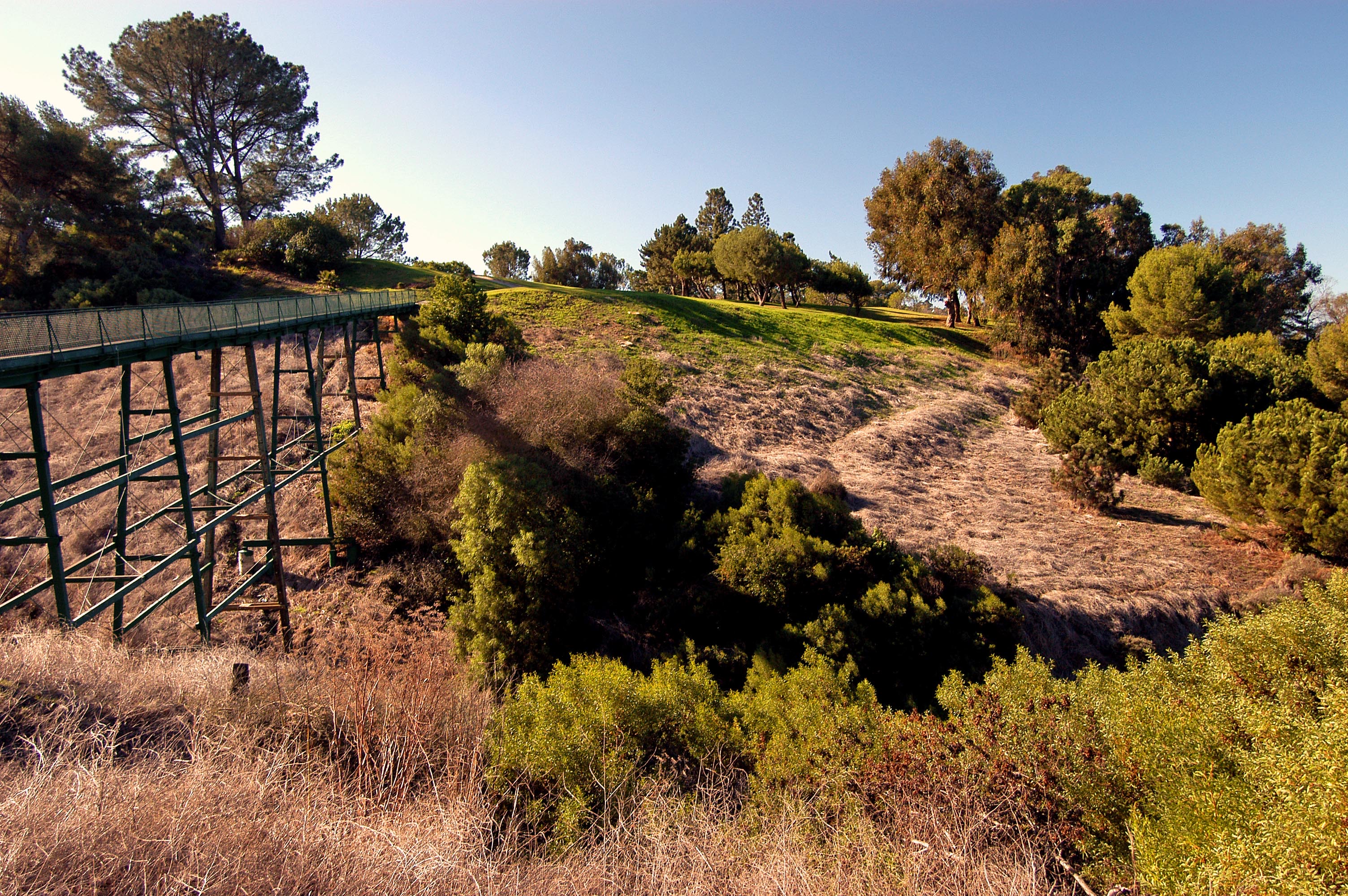
Bel-Air may be the most inventive routing of Thomas's career. When land expected for the second nine was sold for UCLA's new campus, Thomas and Bell made a difficult canyon property work with tunnels, an elevator and a suspension bridge. Holes descend into ravines, climb out again and repeatedly change direction, scale and setting.
Decades of alterations blurred parts of that design. Beginning after the 2017 U.S. Amateur, architect Tom Doak and Renaissance Golf Design restored lost contours, removed later hazards and recovered more of Thomas's strategic intent. The result reinforces a defining Thomas idea: originality comes from responding to the site, not repeating a recognizable formula.
Riviera Country Club — Pacific Palisades, 1927
Members of the Los Angeles Athletic Club commissioned Riviera for Santa Monica Canyon, and Thomas agreed to design it without a fee. The course opened in 1927 after 18 months of construction, with Bell overseeing much of the work. Its sequence includes the Redan-influenced 4th, the bunker-in-the-green 6th, the endlessly debatable 10th and the amphitheater finish at 18 — four famous holes that ask entirely different questions.
Riviera has remained a championship test without surrendering its strategic identity. It hosted Ben Hogan's 1948 U.S. Open victory, the 1983 and 1995 PGA Championships, the 2026 U.S. Women's Open and generations of Los Angeles Opens and Genesis Invitationals. It is also scheduled for Olympic golf in 2028 and another U.S. Open in 2031. The course's relevance a century later is the strongest evidence that Thomas designed problems rather than merely hazards.
Wilson Golf Course — Griffith Park, 1927
Wilson completed Thomas's 36-hole municipal vision for Griffith Park when it opened in 1927. It used parts of the earlier municipal links and shared holes with Harding before later work separated and lengthened the courses. Wilson hosted the Los Angeles Open from 1937 through 1939, bringing players such as Ben Hogan, Byron Nelson, Sam Snead and Babe Didrikson Zaharias to public golf in the park.
The current course is not a museum piece: freeway construction and multiple remodels changed it substantially. The SCGA history identifies 11 surviving Thomas holes. At just over 7,000 yards from the back tees, Wilson is now the longer of the Griffith Park pair, but its sloping fairways and strategic approaches still make position more valuable than indiscriminate power.
Los Angeles Country Club, North Course — 1927–28 Redesign
Thomas's relationship with LACC began earlier in the decade, when he helped execute Herbert Fowler's work on the club's Beverly Hills property. In 1927–28, Thomas and Bell returned for the comprehensive redesign that gave the North Course its enduring identity. They widened choices, repositioned greens and bunkers and used the site's barrancas as diagonal hazards rather than scenery.
By the early 2000s, trees, narrowed fairways and altered features had concealed much of that strategy. Gil Hanse, Jim Wagner and Thomas biographer Geoff Shackelford led a restoration beginning in 2009–10, reopening vistas, recovering barrancas and rebuilding the flexible “course within a course.” The restored North hosted the 2017 Walker Cup and the 2023 U.S. Open, won by Wyndham Clark — a modern championship staged on ideas conceived a century earlier.
The Courses Beyond This List
Thomas's Southern California work extended beyond these six. He and Bell created influential courses at Ojai Valley Inn and La Cumbre in Santa Barbara, worked at Red Hill in Rancho Cucamonga and designed Fox Hills in Culver City, which has been lost to development. Stanford Golf Course, opened in 1930, was among their final collaborations. Some early layouts were rebuilt and others disappeared, one reason Thomas's reputation rests on a small number of surviving masterpieces.
Health curtailed Thomas's work near the height of his reputation. He died of a heart attack at his Beverly Hills home in 1932, aged 58. His design career was brief enough to be measured in years rather than decades, but his 1927 book preserved the thinking behind the courses and helped later architects recognize what had been lost through narrowing, tree planting and piecemeal alteration.
Which Thomas Courses Can the Public Play?
Harding and Wilson are the two broadly public choices. Both are operated by the City of Los Angeles, share a Griffith Park clubhouse and practice facilities, and accept public tee-time reservations. Riviera, Bel-Air and LACC are private clubs that generally require a member invitation to play. Palos Verdes is also private, but verified Palos Verdes Estates residents may book afternoon play for a green fee; for everyone else, member-hosted access applies. Attending a championship can reveal one of these courses, but it is not a way to play it.
Start with Harding if you want the earlier, more compact municipal test, or Wilson if you prefer the longer course. Neither survives exactly as Thomas drew it, but that is part of the value of playing them: they show how Golden Age strategy can persist inside a heavily played city facility rather than behind a private gate.
Why George C. Thomas Jr. Still Matters
Thomas gave Los Angeles more than a collection of famous holes. He showed that width could create decisions, that natural drainage could double as strategy, that a short hole could be more demanding than a long one and that one course could change character through tees, pins and angles. Modern restorations at LACC and Bel-Air did not manufacture new relevance; they uncovered choices that had been there all along.
His legacy is best measured by concentration and durability, not volume. In one city, golfers can watch championships on three landmark private courses, study a rugged coastal collaboration at Palos Verdes and book a public round over surviving pieces of his municipal plan. Few architects left a richer local vocabulary.
This post is part of our series on the people who shaped Los Angeles golf — meet the rest in The Most Influential Figures in Los Angeles Golf.