Riviera at 100: A Century of Championship Golf in Pacific Palisades
Drive west on Sunset Boulevard until the road starts to bend toward the ocean, and just before you reach the bluffs of Pacific Palisades you'll pass a modest gate that hides one of the most consequential pieces of ground in American golf. Riviera Country Club turns 100 this year, and the Riviera Country Club history packed into that single canyon — a record-shattering U.S. Open, an Olympic Games (with another on the way), Hollywood royalty, and nearly every great player of the last century — is really the story of Los Angeles golf itself.
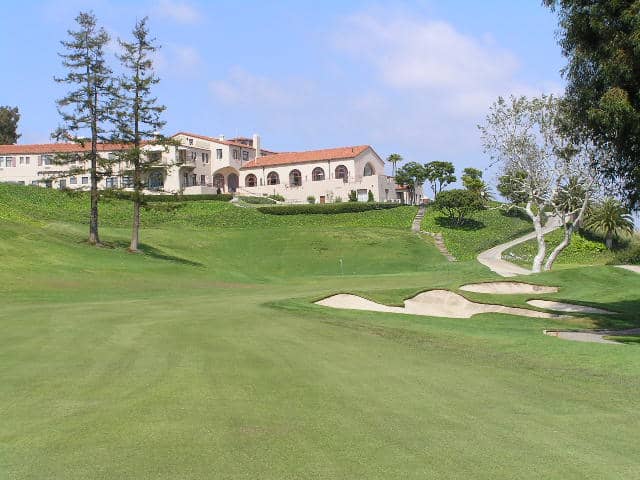
A Course Rises from Santa Monica Canyon (1926)
Riviera began not as a country club at all, but as a project of downtown's Los Angeles Athletic Club, which founded the club in 1926. It was one of several institutions the LAAC established in that era — the California Yacht Club (1922) was another — that later became separate entities. The course opened in 1926 as the Los Angeles Athletic Club Golf Course, occupying the floor of Santa Monica Canyon below the Palisades.
The architect was George C. Thomas Jr., a Philadelphia blueblood — his father was a partner at the investment bank Drexel & Company, where Thomas himself worked until 1907 — who moved west and split his obsessions between golf courses and roses. He cultivated roughly 1,200 rose varieties in California and wrote books on both passions, including Golf Architecture in America (1927), where he laid out his philosophy: "When you play a course and remember each hole, it has individuality and change."
Thomas did not work alone. William P. "Billy" Bell, his longtime collaborator, helped design and plan the course and oversaw the labor force that built it from scratch in the canyon. The bill came to $243,827 — an enormous sum for the era and one of the most expensive golf course construction budgets in history to that point. In the same remarkable stretch, Thomas and Bell also produced Bel-Air Country Club (1926) and the redesign of Los Angeles Country Club's North Course (1927–28) — a trio of Westside designs that still anchors championship golf in Los Angeles a century later.
Hollywood's Playground
Riviera's location — minutes from the star-filled neighborhoods of Brentwood and Beverly Hills — made it a favorite haunt of the movie business. Humphrey Bogart, Dean Martin, Walt Disney, Gregory Peck, and Mary Pickford were all members over the years. That golden-age glamour came with the era's ugly exclusions, though: like many elite American clubs of the period, Riviera discriminated in who it let through the gate, and in the early 1950s the club did not allow Jews on the premises — a policy composer Randy Newman has recounted from his own family's experience. It is a part of the Riviera story that belongs in any honest centennial accounting.
The club's history intersects with film in stranger ways, too: Conrad Veidt, the German actor best remembered as Major Strasser in Casablanca, died of a heart attack while playing golf at Riviera in 1943.
The club was more than a golf course in its early decades. When Los Angeles hosted the 1932 Summer Olympics, Riviera staged the equestrian dressage events and the riding portion of the modern pentathlon — the club's first Olympic moment, 96 years before its second. The equestrian tradition ran deep enough that a young Elizabeth Taylor trained at Riviera for her breakout role in National Velvet (1944). And the horses left one permanent mark on the golf course, as we'll see below.
Hogan's Alley
No player is more tightly bound to Riviera Country Club history than Ben Hogan, and the nickname the course still carries — "Hogan's Alley" — was earned in a furious 18-month stretch. Hogan won the Los Angeles Open at Riviera in 1947 and again in 1948, and then, in June 1948, he won the biggest championship in American golf on the same fairways.
The 1948 U.S. Open
The 1948 U.S. Open, played June 10–12 at Riviera, was the first U.S. Open ever contested on the West Coast. Hogan shot 276 — eight under par — to shatter the championship's 72-hole scoring record of 281, set by Ralph Guldahl in 1937, by five strokes. Jimmy Demaret finished second at 278. Hogan's 276 stood as the U.S. Open's aggregate scoring record for 19 years, until Jack Nicklaus bettered it by a stroke at Baltusrol in 1967; his eight-under-par mark in relation to par proved far more durable, standing until Tiger Woods reached 12 under in 2000.
That week carried significance beyond the scoreboard. Ted Rhodes became the first African-American golfer to compete in the U.S. Open since 1913; he made the cut and finished 51st — a milestone in the long, slow dismantling of professional golf's color barrier, and it happened in Pacific Palisades.
The Comeback, January 1950
On February 2, 1949, Hogan's car collided head-on with a Greyhound bus in West Texas, leaving him with a fractured pelvis, a broken collarbone, a broken ankle, and injuries so severe that his return to competitive golf was in doubt. When he did come back — roughly 11 months later, in January 1950 — he chose the Los Angeles Open at Riviera. On legs that could barely carry him 72 holes, Hogan shot four-under 280 and tied Sam Snead, forcing a playoff. Snead won it, 72 to Hogan's 76, but the result hardly mattered; the comeback at Riviera set up Hogan's "Miracle at Merion" U.S. Open victory that June. The canyon off Sunset was the stage for one of the most stirring returns in sports history.
The LA Open's Permanent Home
The Los Angeles Open predates Riviera's tournament era — it was first played in 1926 at Los Angeles Country Club — and first came to Riviera in 1929. Since 1973, Riviera has been the event's permanent home, and through 2026 the club has hosted more than 60 editions, missing only 1983, 1998, and 2025.
The tournament has evolved with the city. Genesis took over title sponsorship in 2017, and the event — organized in partnership with Tiger Woods' foundation — became an invitational in 2020, with a smaller field and larger purse befitting one of the PGA Tour's marquee stops. The Charlie Sifford Memorial Exemption, established in 2009, honors the pioneering Black golfer who won the Los Angeles Open in 1969 and gives a promising player from an underrepresented background a spot in the field each year.
Woods' own Riviera story began long before he hosted the event: in 1992, as a 16-year-old high school sophomore playing on a sponsor's exemption, he made his very first PGA Tour start at Riviera, shooting 72–75 to miss the cut by six. Remarkably, in a career that conquered nearly everything else, Woods never won at Riviera — neither did Jack Nicklaus. Recent champions read like a modern who's-who anyway: Bubba Watson won three times (2014, 2016, 2018), Adam Scott twice (2005, 2020), and Dustin Johnson took the 2017 edition.
Kikuyu, the Sixth, and the Tenth
Part of what makes Riviera's championship record so rich is that the course itself never stopped being interesting. Its defining texture is kikuyu grass — a dense, grabby pasture grass native to East Africa that was used on a nearby polo field in the 1930s and planted on hillsides for erosion control. Over the decades it invaded the golf course and became the dominant turf, giving Riviera's fairways and rough a playing character found almost nowhere else in championship golf. The greens, meanwhile, are famously fickle Poa annua.
Two holes have become architecture-class staples. The par-3 sixth features a bunker sitting in the middle of the green — a Thomas flourish that still forces putts around (or chips over) sand a century later. The tenth, a 315-yard par 4, is routinely cited as the best short par 4 in the world: drivable, but guarded so cleverly that birdie and bogey are separated by a few feet of kikuyu. In 1992, Ben Crenshaw and Bill Coore restored the bunkering to its original Thomas-era appearance, part of the reason the course still plays as its architect intended.
Fire, Recovery, and a Second Century
Riviera's centennial arrives shadowed by the hardest chapter in Pacific Palisades history. The Palisades Fire ignited on January 7, 2025, burned 23,448 acres over 25 days, destroyed 6,837 structures, and killed 12 people, leveling much of the surrounding neighborhood. That February's Genesis Invitational was moved to Torrey Pines in San Diego as the community began to recover.
Golf returned to the canyon quickly, and the club's second century opened at full speed. In June 2026, Riviera hosted the U.S. Women's Open for the first time; Nelly Korda won at 276 (−8) — the same eight-under total Hogan posted in 1948 — for her fourth major title, holding off Charley Hull and Gaby López by one. Next comes golf at the 2028 Summer Olympics, making Riviera a two-time Olympic venue in two different sports, followed by the 131st U.S. Open in 2031 — the club's second, 83 years after Hogan's first.
One hundred years after George Thomas walked into Santa Monica Canyon with Billy Bell and a quarter-million-dollar budget, Riviera has hosted a U.S. Open, two PGA Championships, a U.S. Senior Open, a U.S. Amateur, a U.S. Women's Open, an Olympic Games, and the better part of a century of Los Angeles Opens — with an Olympics and another U.S. Open on the calendar. For Angelenos, it remains the rare landmark that is somehow both exclusive and communal: hidden behind a gate off Sunset, yet every February (and now far beyond), the whole golf world comes to the Palisades.

