The 2023 U.S. Open at LACC: The Major a Century in the Making
The Course Los Angeles Rarely Got to See
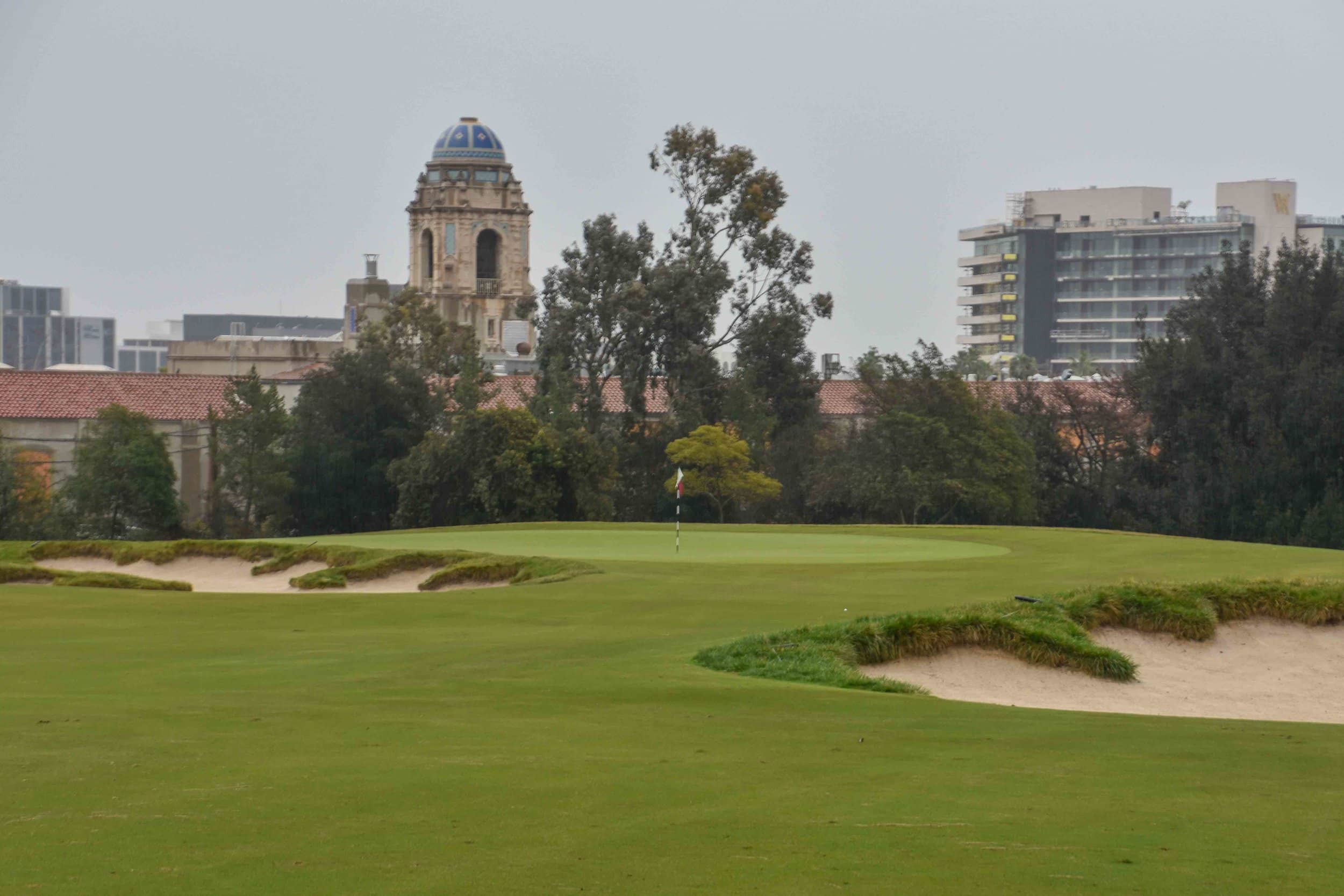
Drive down Wilshire Boulevard where Beverly Hills gives way to Westwood and you can pass it without knowing: behind a screen of trees and hedges lie more than 300 acres of golf — roughly 325 by most published accounts — amid some of the most expensive real estate in America, land valued in outside analyses at somewhere between six and nine billion dollars. For more than a century, the Los Angeles Country Club was famously private, and while the public did get occasional glimpses over the decades — amateur championships, a handful of early Los Angeles Opens, the 2017 Walker Cup — its North Course had never hosted a men's major championship, and for most of the modern era it stayed far from the spotlight.
Then, for four days in June 2023, the gates opened wide. The 123rd U.S. Open came to LACC's North Course — the first U.S. Open played in Los Angeles since Ben Hogan's landmark win at Riviera in 1948, and the first major championship ever contested at the club. What unfolded was a record-tying scoring barrage, a Sunday duel with Rory McIlroy, and a breakthrough win by Wyndham Clark, who pointed to the sky for his late mother when the final putt fell.
One caveat up front: "a century in the making" is rhetoric, pegged to the course that opened on this property in 1911 and to George Thomas's 1927–28 redesign. The documented courtship was shorter — by the USGA's own account, it pursued LACC for at least 26 years before the club said yes. This is the story of how that pursuit finally paid off.
A Club That Never Wanted the Spotlight
The Los Angeles Golf Club was organized in the fall of 1897, when a handful of enthusiasts laid out a crude course on a 16-acre lot at Pico and Alvarado — a course remembered as "The Windmill Links," named for a makeshift clubhouse crafted from the bottom of an abandoned windmill. The club moved three times in its early years: first to Pico Heights, where the course was dubbed "The Convent Links," then to the northeast corner of Pico and Western, and finally to its current property along what would become Wilshire Boulevard, where an 18-hole course reopened on May 30, 1911 — later expanded to 36 holes as the city grew up around it.
From early on, LACC cultivated a reputation — long and widely reported — as an old-money club that kept its distance from the entertainment industry powering the city around it. And exclusivity on the Westside had a darker dimension: in the early twentieth century, Jewish Angelenos were shut out of the city's elite social clubs — a pattern that histories of the era describe across the establishment club world, and one that, by many published accounts, did not simply fade with the period. That exclusion is inseparable from the story of golf on L.A.'s Westside.
The answer came in 1920, when Samuel Newmark, Louis Issacs, Karl Triest, and Joseph Y. Baruh founded Hillcrest Country Club in Cheviot Hills as the first country club for the city's Jewish community. Hillcrest became an institution in its own right — home to a legendary Friday comedians' round table with Jack Benny, George Burns, the Marx Brothers, Milton Berle, and Danny Kaye (Alan King called it "like a college for comedy"), and later to members like Sandy Koufax.
For all its privacy, LACC was not a complete stranger to competition. It hosted the Los Angeles Open five times — in 1926, 1934, 1935, 1936, and 1940 — along with the 1930 U.S. Women's Amateur and the 1954 U.S. Junior Amateur. But after mid-century the club largely stepped back from tournament golf, and for decades Riviera carried the city's professional banner.
The Captain's Masterpiece
The irony was that behind those hedges sat one of American golf architecture's great works. George C. Thomas Jr. — born in Philadelphia in 1873, a World War I Army Air Service captain (friends simply called him "The Captain") and celebrated rose breeder — moved to California in 1919 and, in a remarkable burst of productivity with construction partner William P. Bell, created the Westside's holy trinity: Bel-Air (1926), Riviera (1927), and the full 1927–28 rebuild of LACC's North Course. Thomas literally wrote the book on his craft — Golf Architecture in America, published in 1927 — preaching that a course should have such individuality that a player remembers every hole in sequence.
The North Course was exactly that: a par 70 draped over a natural barranca, with wild, tilted greens and an unusually varied set of par 3s. But decades of tree planting and softening edits buried much of Thomas's character, and the course drifted out of the national conversation. That changed in 2010, when architect Gil Hanse — working with historian and Thomas scholar Geoff Shackelford — restored the North to the Captain's design, stripping away the overgrowth and resurrecting the barranca, the scale, and the strategic teeth. Soon the course on Wilshire was being ranked among the best in the country.
Seventy-Five Years Without an Open
Los Angeles had hosted exactly one U.S. Open before 2023, and it was a landmark: the 1948 championship at Riviera, the first U.S. Open ever played on the West Coast. Ben Hogan won at 276 (8 under), shattering Ralph Guldahl's 1937 U.S. Open scoring record of 281 by five shots. Hogan's 72-hole total was itself surpassed by Jack Nicklaus's 275 in 1967 and lowered again in 1980 — but his 8-under mark relative to par stood as the championship's best for 52 years, equaled by Nicklaus in 1980 and Lee Janzen in 1993, until Tiger Woods reached 12 under in 2000. Riviera became "Hogan's Alley." And then... nothing. For 75 years, the national championship never returned to the city.
The USGA knew where it wanted to go. By its own account, the association had courted LACC for at least 26 years, and after the Hanse restoration a new generation of club leadership finally said yes — the championship was announced in 2015. First came an audition: the 2017 Walker Cup, played that September on the North Course. The United States routed Great Britain & Ireland 19–7 with a team that reads like prophecy — Collin Morikawa, Scottie Scheffler, Will Zalatoris, Doug Ghim, Maverick McNealy. It was only the second Walker Cup ever played in California, and it confirmed what the architecture crowd already knew: the North Course was ready for the biggest stage.
Four Days in June
When the U.S. Open arrived on June 15, 2023, the North Course stretched to 7,423 yards at par 70 — and promptly shocked everyone by giving up birdies in bunches. On Thursday, Rickie Fowler and Xander Schauffele each shot 8-under 62, tying the lowest single round in men's major championship history. Two record rounds, same course, same day, at a U.S. Open — the tournament famous for protecting par. Fowler kept going, reaching 130 after 36 holes to tie the Open's halfway scoring record.
Not everyone was charmed. Brooks Koepka and Matt Fitzpatrick were among the players who groused about blind tee shots and lightning-fast fairways, and the event itself had an unusual feel: hemmed in by Beverly Hills, daily attendance was capped around 22,000, far below a typical modern Open. But the leaderboard delivered. By Saturday night, Fowler — chasing a feel-good first major — was tied at 10 under with Wyndham Clark, a 29-year-old from Denver who had never finished better than 75th in a major. Rory McIlroy, nine years removed from his last major title, lurked one back.
Sunday: "Play Big"
Clark's mother, Lise, died of breast cancer in August 2013 at age 55, during his freshman year of college; her parting advice — "play big" — became his mantra and later the name of his foundation. After stops at Oklahoma State and Oregon (where he played for coach Casey Martin), Clark toiled in professional anonymity until 2023, when work with sports psychologist Julie Elion helped unlock everything: a first PGA Tour win at the Wells Fargo Championship in May, and a month later, the final group at a U.S. Open in just his seventh major start.
Paired with Fowler in Sunday's last group, Clark held steady while Fowler crumbled to a 75. The tournament became a two-man fight: Clark against McIlroy, trading blows across Thomas's barranca. McIlroy's closing 70 set the target at 9 under; Clark, protecting a one-shot lead, played the last holes with veteran nerve and faced a 60-foot putt across the 72nd green. Two putts later, he was the U.S. Open champion at 10-under 270 — rounds of 64-67-69-70 — one clear of McIlroy at 271, with Scottie Scheffler third at 273 and Cameron Smith fourth at 274. Tommy Fleetwood closed with a 63 to become the first player ever with two career U.S. Open rounds of 63 or better, joining Rickie Fowler and Min Woo Lee in a three-way tie for fifth at 275. Clark pointed to the sky for his mother. The $3.6 million winner's check, from a record $20 million purse, was a footnote.
What It Meant for Los Angeles Golf
The 2023 U.S. Open rewrote two reputations at once. Wyndham Clark went from journeyman to major champion in the span of six weeks. And the Los Angeles Country Club stepped from behind its hedges onto golf's biggest stage — a George Thomas masterpiece, restored to full glory, finally playing host to a worldwide audience. For a city whose golf history runs through Riviera, Bel-Air, Hillcrest, and the great municipal tracks of the basin, the week completed a circle that opened with Hogan in 1948: Los Angeles, at long last, was a U.S. Open town again.
And for anyone who watched Fowler's 62, McIlroy's near-miss, or Clark's two-putt in the June gloaming, the lesson was the one Thomas taught nearly a hundred years ago — great architecture, given time, always gets its moment. For more of the city's golf story, read our history of golf in Los Angeles and The Los Angeles Open at 100.

