Hillcrest Country Club: The Club That Answered a Closed Door
Drive west on Pico Boulevard past Century City and you'll pass, in the space of a few blocks, some of the most storied golf ground in Los Angeles. On the south side of the street, behind a discreet hedge at 10000 West Pico, sits Hillcrest Country Club — the club that Jewish Los Angeles built for itself in 1920, at a time when the city's most exclusive clubs would not admit Jewish members. Immediately to Hillcrest's west, on the same side of Pico, stretches Rancho Park, the beloved muni that hosted the Los Angeles Open seventeen times; across the street, on the north side, sprawls the old 20th Century-Fox studio lot. That single stretch of Cheviot Hills holds a century of Los Angeles golf history — and Hillcrest may be its most remarkable chapter.
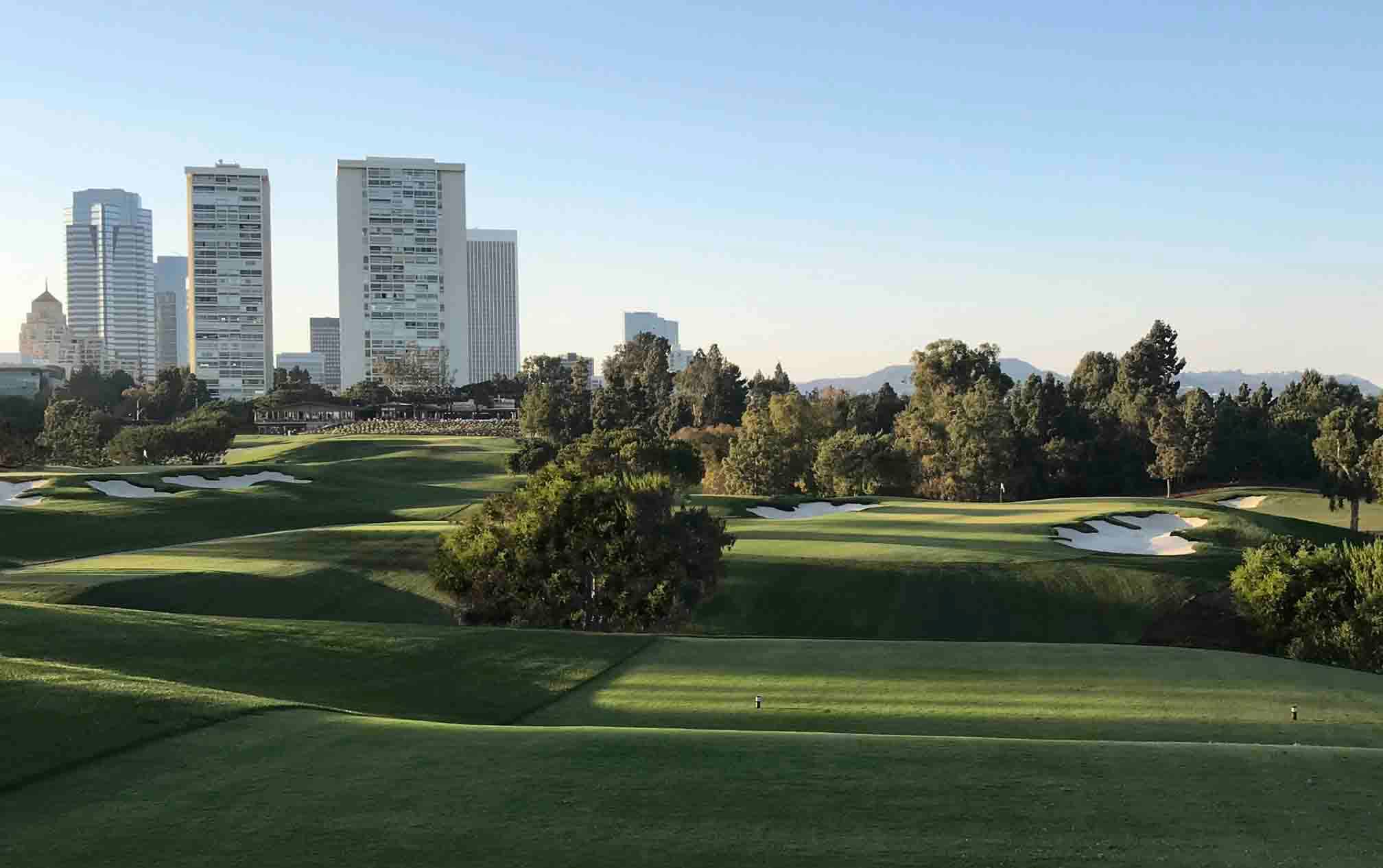
Four Golfers From San Gabriel
The story starts, fittingly, with a golf game. Four players at San Gabriel Country Club — Samuel M. Newmark, Louis Isaacs, Karl Triest, and Joseph Y. Baruh — decided in 1920 to establish a private club of their own, a plan the club's own history cheerfully describes as a "far-fetched notion." The context was hard to miss: by most accounts of the era, Jews were excluded from many of Los Angeles's elite social clubs. Whatever mix of ambition and necessity drove the founders, the surest way for the city's Jewish community to get a country club was to build one.
The foursome went looking for land and found what the club's history describes as "a charming little parcel of rolling hills on Pico Boulevard," owned by the Huntington Land and Water Company. Newmark and Isaacs put up $5,000 of their own money for a purchase option; the new club's board then authorized buying 142 acres for $50,000, plus $550,000 to build the golf course and clubhouse.
Willie Watson — the Scottish-born architect whose California resume includes some of the state's foundational designs — laid out the course through the rolling terrain of what is now the Cheviot Hills area of west Los Angeles. In 1920, the land across Pico was just land; only later would it become the 20th Century-Fox studio lot. That was a stroke of geographic luck nobody could have engineered — and it would end up mattering enormously, twice.
Hollywood Moves In
As the movie business boomed in the 1920s, its leading figures — many of them Jewish, and unable, by the club's own account, to join most of the swank clubs of the day, such as Bel-Air, Wilshire, Riviera, and the Los Angeles Country Club — found their way to Pico Boulevard. The club's history records applications from an astonishing roster of studio royalty: Jack Warner, Samuel Goldwyn, Adolph Zukor, and Louis B. Mayer among them. (For the wider story of golf and the entertainment industry, Hillcrest is only the first stop.)
By its own telling, Hillcrest "quickly became recognized as one of the premier country clubs in the nation" — the club's phrase, though the guest list made it hard to argue with. Its social center of gravity, however, was never the first tee. It was a large oak table in The Grill.
The Round Table
Known simply as "The Round Table," that oak table became the Friday lunch home of a staggering roster of comedians: Jack Benny, George Burns, Groucho and the Marx Brothers, Milton Berle, George Jessel, Eddie Cantor, Al Jolson, Danny Kaye, and later Sid Caesar, Don Rickles, and Alan King. Their camaraderie predated the club — by the club's own account it went back to vaudeville days at a greasy spoon called Wolpin's off Times Square — but Hillcrest gave it a permanent address. And most of them were there for the same reason the club existed: as the club's history notes, they were Jewish and couldn't join most of the era's swank clubs.
Groucho Marx, characteristically, made the point better than any historian could: "As you may recall, the Hillcrest is the only country club in all of Greater Los Angeles that will accept Talmudic scholars such as myself as members." Milton Berle, who joined in 1932 for a $275 initiation fee, described the place as "a dining club with golf." And Groucho's son Arthur — who inherited his father's membership through Groucho's will — remembered that "in the heyday of the Round Table, in the '40s, '50s and '60s, it was probably the most amusing place to lunch in all the world."
December 1929: A Major Comes West
For all the comedy, Hillcrest's golf pedigree is serious. In December 1929 — barely nine years after the land purchase — the club hosted the PGA Championship, the first major championship ever played in the western United States. The event had originally been slated for Santa Barbara before being relocated to Hillcrest.
The championship, played December 2–7 at match play, produced one of the great runs in the event's history. Defending champion Leo Diegel beat Gene Sarazen 3 and 2 in the quarterfinals, then took down Walter Hagen 3 and 2 in the semifinals — this against a man who had gone 35–2 in PGA Championship match play during the 1920s. In the 36-hole final, Diegel closed out Johnny Farrell 6 and 4 to successfully defend his title. The total purse: $5,000, with $1,000 to the winner. Different times.
Hillcrest wasn't done with tournament golf. The Los Angeles Open came to Pico Boulevard twice: Macdonald Smith won there in 1932, and in January 1942 a young Ben Hogan opened his season by winning the L.A. Open at Hillcrest — one of the early trophies in what became one of golf's most decorated careers.
Oil Under the Fairways
Then came the twist that no founding foursome could have planned. In 1953, oil drilling was permitted on the 20th Century-Fox lot, and the oil field beneath west Los Angeles didn't stop at anyone's property line. In June 1957, as TIME reported, the Los Angeles City Council voted on a dezoning measure tied to the Hillcrest property — one with unusual grassroots support, since roughly 95 percent of the surrounding homeowners had already signed agreements with the drillers, whose plan was to slant-drill from the club's 145-acre course. The same TIME dispatch noted just how coveted a Hillcrest membership had become: the club was accepting new members only from applications filed before January 1, 1952.
Hillcrest wasn't alone. The same article described an even more elaborate arrangement at the Los Angeles Country Club — one of the clubs whose exclusions had helped bring Hillcrest into being — which spun off a subsidiary oil company called Westla, entitled to royalties of at least 32 percent, and gave one share of its stock (estimated value: $2,000) to each of the club's 802 regular members; LACC's membership price, TIME noted, had climbed from $3,000 in 1953 to $10,000. Oil, it turned out, was the great leveler of Los Angeles club life: it didn't care who your members were, only where your fairways sat.
In Hillcrest lore, the oil era became part of the club's identity. The story is often told that royalties flowed to members for decades, and that pre-strike memberships were treasured enough to be passed down through families. If even half the lore is true, it may be the rare country club membership in America that ever paid you.
Doors Open Wider
A club founded because doors were closed spent its later decades opening its own. Danny Thomas, the Lebanese-American Catholic entertainer, became Hillcrest's first non-Jewish member. Dinah Shore — who didn't take up golf until age 52 and went on to found the LPGA tournament now known as the Chevron Championship — became the club's first female member, en route to the World Golf Hall of Fame. The membership rolls came to include Frank Sinatra, Sidney Poitier, Jack Lemmon, Dodgers owner Walter O'Malley, and the Dodgers' greatest left arm, Sandy Koufax. In more recent years, members have included Doug Emhoff, the entertainment lawyer and husband of former Vice President Kamala Harris.
The comedians' verdict on all this evolution was delivered, naturally, as a punchline. Asked about getting into Hillcrest, David Steinberg observed that "there is no discrimination, but it sure helps if you're Jewish and a comedian."
Hillcrest Today
The golf course got its own second act. In 2019, architect Kyle Phillips — best known for Kingsbarns in Scotland and the acclaimed rebuild of the California Club of San Francisco — completed a comprehensive renovation of Watson's century-old layout, work that earned a feature in Golf Course Architecture magazine. The modern course plays 6,489 yards, proof that in Cheviot Hills, as at Rancho Park next door, Los Angeles golf has never needed brute length to be interesting.
Hillcrest remains strictly private, and its philanthropy-minded culture — the club's stated mission includes "preserving our honored tradition of philanthropy and community service" — remains central to its identity. You can't just tee it up there. But you can stand on Pico Boulevard, with Rancho Park's public fairways next door and the old Fox lot across the street, and read a century of Los Angeles history in a single block: a city whose grandest clubs once kept their doors closed, and the club that answered by building a better room — with a rounder table — behind its own.
Hillcrest at a Glance
Founded: 1920, by four golfers from San Gabriel Country Club
Location: 10000 West Pico Boulevard, Los Angeles (Cheviot Hills)
Original architect: Willie Watson; renovated by Kyle Phillips, 2019
Championships: 1929 PGA Championship (Leo Diegel); Los Angeles Open 1932 (Macdonald Smith) and 1942 (Ben Hogan)
Claims to fame: the comedians' Round Table; the 1950s oil boom beneath Pico; a club built by and for Jewish Los Angeles

