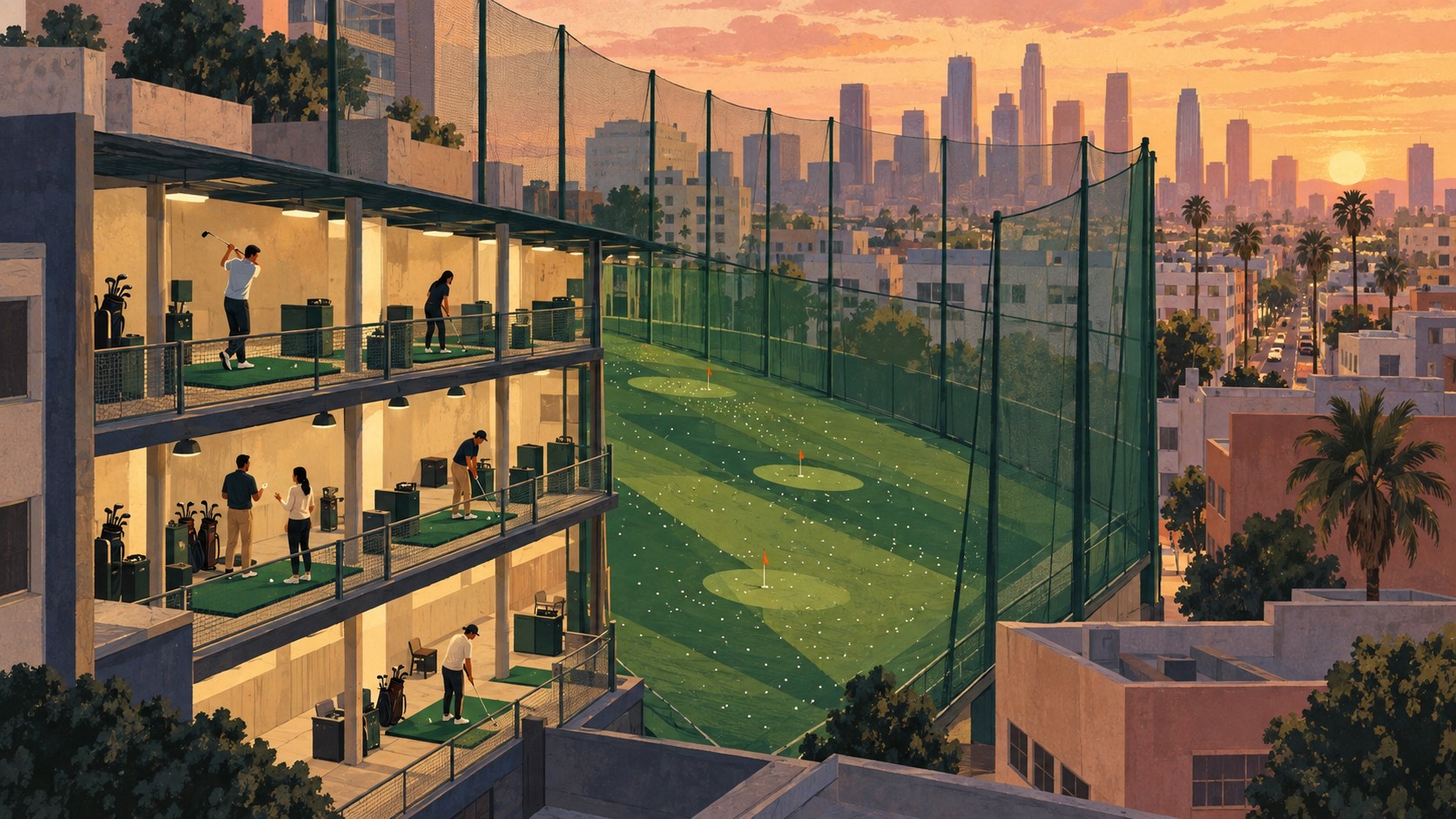
At Aroma Spa & Sports on Wilshire Boulevard, golf goes up instead of out. The operator describes a four-level, 150-yard semi-indoor range, with 15 tee stations on each floor. Its range is open to the public. You can work on a swing in the middle of Koreatown without setting foot on a golf course.
It is a useful place to begin a different history of Los Angeles golf: one concerned with where people practice between rounds, and how that practice fits into a neighborhood.
The recent simulator boom gives that history a fresh reason to be read. The National Golf Foundation’s April 2025 report counted 8.1 million U.S. simulator users in 2024, compared with 3.6 million five years earlier. Those are national figures, not a measure of Koreatown. Here, the story of golf away from the course reaches much further back.
Before the screen
In 1995, the Los Angeles Times found mostly Korean immigrant patrons. Golfer Margie Han’s explanation: “It’s how we socialize.”
The Los Angeles Business Journal’s May 1997 account found three net-enclosed ranges within a mile and a half: La Ma, Hansohl Healthland and Olympic Golf Driving Range. Their busiest periods clustered around the working day. Weekends were quieter as customers headed to courses.
The same report complicates any easy success story. La Ma co-owner Sun Roh said she would consider selling, and Hansohl’s property had entered bankruptcy. Busy stalls and a durable business were different things. Neighborhood golfers had created demand, but the ranges still faced the costs and uneven hours of city recreation.
That distinction gives the history its texture. These were places to hit balls into nets, with the business of keeping a range open happening alongside the practice. Calling them early simulators would erase what made them useful on their own terms.
A range on Wilshire
In October 1998, the Los Angeles Times reported plans for Aroma Sporex, including a four-level golf range.
Today, Aroma’s own description puts golf alongside a gym, an indoor pool and spa facilities. That combination is part of the appeal of looking at the building as a whole. Golf occupies space within a larger place for exercise and leisure, rather than requiring a trip organized entirely around the game.
The stacked tees offer an especially clear architectural answer to a golfer’s question: where can I practice nearby? The building makes room vertically. A simulator answers a related question through technology, using a screen and measured shots to bring a much larger playing landscape into a small room.
There is a resemblance in purpose. The sources reviewed for this story do not establish a shared owner, a succession of businesses or a direct influence on later studios. Aroma belongs in this history without needing to become the final chapter of every earlier range.
A private bay, a different arrangement
At 4256 West Third Street, Perfect Par Golf Studio offers a contemporary contrast: a private, single-bay space that operates around the clock. Access depends on the membership package; some plans restrict the hours a member can book.
Its FAQ lists a Foresight Falcon simulator and PuttView putting system, and allows a member to bring up to three guests, including a coach, at no extra charge. Private does not necessarily mean solitary. It means the booking controls who shares the room.
The contrast with a range is as much about the experience as the equipment. Sharing a practice floor and reserving a room with invited guests offer different kinds of company.
What connects these places for a local golfer is the possibility of a shorter visit: time spent practicing without the commitment of an entire round. Our Los Angeles simulator guide covers more options for that kind of session.
Making room for everyday golf
A history built around championship venues can miss the places where a swing is learned, lost and worked on again. Practice facilities deserve attention for that everyday role. A net, a mat and a place close enough to use regularly can matter as much to a golfer’s week as the course booked for Sunday.
Koreatown gives that idea a local history. Reading the older accounts beside today’s operator information brings the neighborhood’s practice spaces into view without turning them into a claim that one community invented indoor golf. They are worth knowing as part of Los Angeles in their own right.
If you want to practice
Aroma is at 3680 Wilshire Boulevard, Unit 301. Its posted range hours are 6 a.m.–11 p.m. on weekdays and 7 a.m.–11 p.m. on weekends, with separate holiday hours. Check fees and equipment arrangements before visiting.
For Perfect Par, consult the operator’s current membership and booking terms. Its homepage and FAQ disagree on the number of included monthly hours, so confirm that detail directly before joining.
Editor’s note, September 17, 2026: This article has been revised to distinguish netted ranges from simulator studios and to include the financial difficulties described in historical reporting. The cover is an AI-generated editorial illustration, not an archival photograph or a depiction of a specific venue.