Rustic Canyon: How a $3 Million Course Became an American Public-Golf Classic
Rustic Canyon Golf Course is considered one of America's best public courses because it combines Golden Age strategy, firm ground-game conditions, a distinctly Southern California landscape, and genuine daily-fee access. GOLF ranked it No. 45 on its 2024–25 list of courses anyone can play, and Golfweek placed it in a tie for No. 60 among America's public-access courses in 2026. What separates it from many ranked peers is how little of that appeal depends on lavish spending or manufactured scenery.
Opened in Moorpark in 2002, Rustic Canyon was built for about $3 million by Gil Hanse, Jim Wagner, and Los Angeles golf writer Geoff Shackelford. They moved only about 17,000 cubic yards of earth, left a protected wash and even an old earthquake fissure in place, and made width—not rough, water, or forced carries—the engine of the design. The result still feels less like a product than a discovery.

A Public Course Born from Restrictions
Rustic Canyon began with a piece of land most developers did not want. In 1999, Ventura County offered a 700-acre property in Happy Camp Canyon for long-term lease, with one crucial condition: the project had to remain a moderately priced public golf course. The sandy canyon floor looked ideal for golf, but a broad wash crossing the property was environmentally sensitive, and the county placed strict limits on earthmoving.
Craig Price, a former American Golf Corporation executive, won the lease and connected with Shackelford, who brought in Hanse. Where other teams saw permitting trouble, the three designers saw permission to work the way they already wanted to work. As The Fried Egg's history of the course explains, the environmental restrictions aligned with their minimalist instincts. Instead of bulldozing obstacles into submission, they would mow fairway corridors through the best ground and leave the canyon's native hazards alone.
Construction began in May 2001 and was substantially complete that November. There were no detailed blueprints dictating every contour. Hanse and Wagner shaped the greens and bunkers in the field, using the existing landforms as their guide. The team had a $4 million golf-course budget and finished for about $3 million. When Rustic Canyon opened in April 2002, Golf Digest named it the Best New Affordable Public Course in America.
Even the name carried the idea. According to The Fried Egg's course profile, Alice Dye once looked at an overwatered Riviera Country Club and asked why people could not build rustic courses anymore. Shackelford remembered the line. In Moorpark, the name became a brief: let California look like California.
Why Width Makes Rustic Canyon More Strategic
Rustic Canyon's fairways are wide so golfers can choose among meaningful routes, not so they can stop thinking. The first landing area is roughly 70 yards across. On another course, that might make the opening drive nearly irrelevant. Here it gives every golfer a chance to put a ball in play, then makes the position of that ball matter on the next shot.
Shackelford summarized the design model as “width, width and more width” in a 2006 interview with architect Ian Andrew. Width helps average golfers keep moving, but it also creates optional angles for stronger players. The safe side of a fairway usually leaves a longer or more awkward approach. Challenge the wash, a bunker, or an out-of-bounds line and the green may open along its long axis. The golfer decides how much discomfort to accept now for an easier shot later.
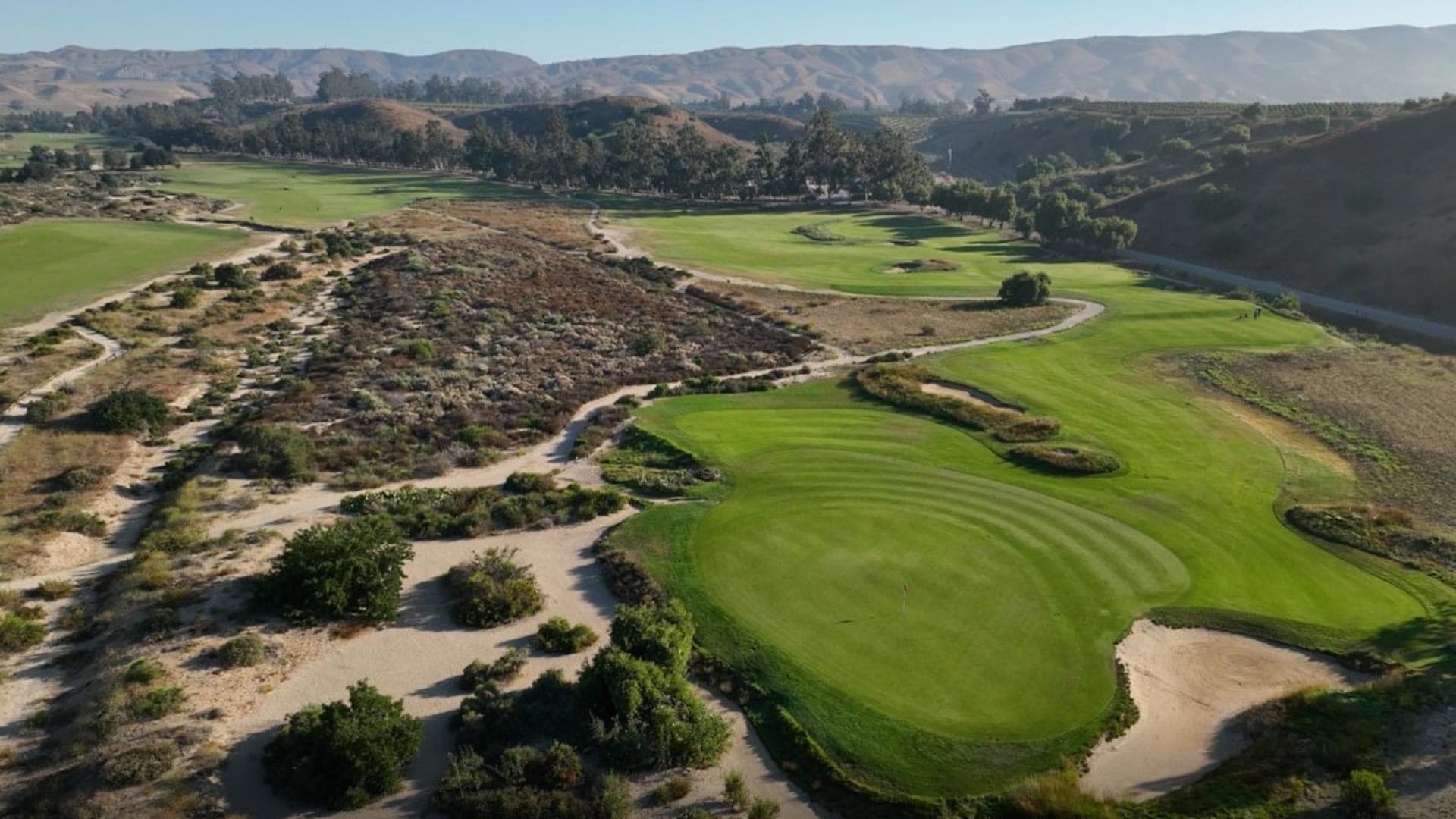
The strategy continues at the greens. They are broad and full of shoulders, spines, and bowls, with closely mown runoffs around them. A ball can land short and feed toward a flag, or touch the wrong contour and finish farther away than where it started. That makes the course playable in the air or along the ground, but it also makes the daily pin position part of the architecture. The correct side of a 60-yard-wide fairway can change from one round to the next.
The Barranca Is the Course's Best Hazard
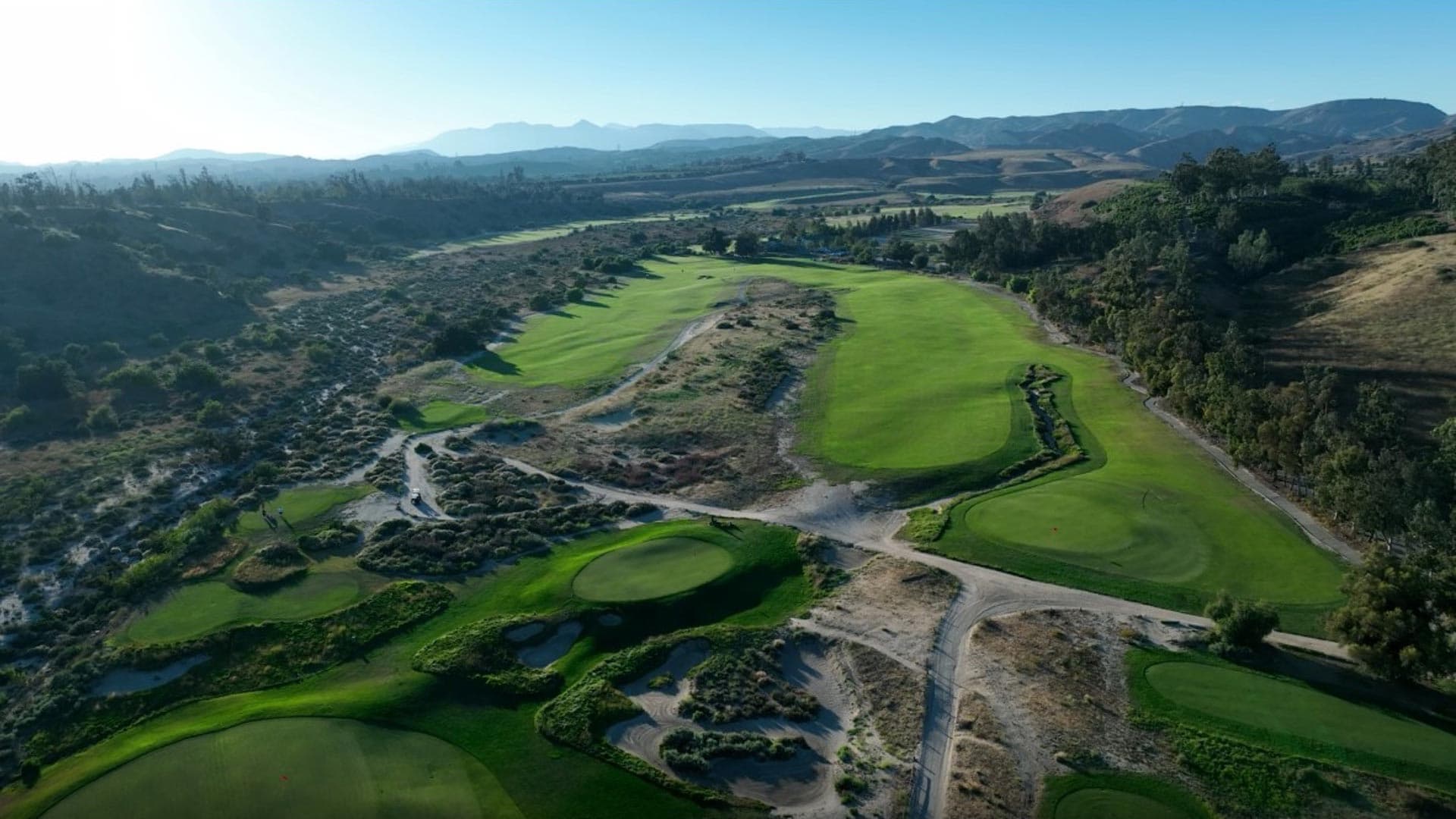
The dry wash running through Happy Camp Canyon is not decorative scenery. It is the organizing feature of the course. Hanse, Wagner, and Shackelford use it in different ways: sometimes it crosses a line of play, sometimes it runs beside the preferred route, and sometimes it sits beyond practical range and shapes only the golfer's eye. Because the team resisted forcing a hole across it at every opportunity, the wash never becomes a repetitive penalty.
That restraint is clearest at the par-5 first. A sandy fissure cuts diagonally across the fairway short of the green, presenting three distinct choices: lay back, carry into the narrowing space beyond it, or attack the green in two. The feature is an old earthquake scar. Many architects would have filled it, formalized it into a creek, or surrounded it with ornamental planting. Rustic Canyon simply made it part of the game.
The sandy soil matters too. It drained naturally, reducing construction and maintenance costs, and it supports the firm conditions the design needs. On a soft course, a broad fairway is merely a large target. At Rustic Canyon, bounce and roll can turn a preferred angle into a real advantage, while wind moving up or down the canyon changes the solution again.
Six Holes That Explain Rustic Canyon
No. 1, par 5: The welcoming drive and diagonal earthquake fissure establish the course's central bargain: plenty of room to begin, followed by a decision that rewards judgment more than power.
No. 3, par 4: At roughly 315 yards from the back tee, this short hole offers split fairways, a possible drive at the green, and a safer route that leaves the more anxious pitch. It is fun without being frivolous.
No. 5, par 5: The fairway lies on a diagonal and the green opens from the right. A player who hugs the wash earns the shortest route and best chance to reach in two; a cautious player can zigzag left, then right, and approach with a wedge. Both routes work.
No. 13, par 5: The horseshoe-shaped green wraps around a deep bunker, so the flag location can shift the ideal second-shot position by dozens of yards. Reach the wrong section and a putt may be less practical than a chip.
No. 14, par 4: The wash creates a Cape-style tee shot: take on more of the diagonal carry for a shorter approach or play away from trouble and accept the longer route. The intimidating view is more severe than the available landing area.
No. 16, par 4: The round's grand view comes from a high tee before the hole plunges through a natural saddle to a bunkerless, pushed-up green. The fairway looks dramatic because the land is dramatic, not because the builders manufactured a spectacle.
For a more technical examination of these angles, The Fried Egg's course analysis traces Rustic Canyon's diagonal geometry to George C. Thomas Jr., whose Los Angeles designs at Riviera, Bel-Air, and Los Angeles Country Club used width and barrancas in similar ways. Rustic is not an imitation of those clubs. It is a public-course continuation of the same ideas.
A Different Idea of Championship Golf
Rustic Canyon arrived during the height of “Tiger-proofing,” when new courses were often sold through back-tee yardage, narrow corridors, penal rough, and claims that they could host a major championship. Rustic offered five par 3s, five par 5s, three short par 4s, expansive fairways, and closely mown recoveries. It was interested in decisions, variety, and repeat play—not defending a scorecard from the best player in the world.
Early reviewers sometimes called the course “fun” as if the word were a qualification rather than the point. That judgment aged badly. Modern architecture criticism now prizes the very traits Rustic Canyon was once asked to defend: width, optionality, firm turf, walkability, naturalness, and the freedom to solve a hole in more than one way.
The course is not flawless. The Fried Egg notes that the short eighth feels squeezed into the routing and that the walks from 12 to 13 and 17 to 18 are awkward. The two nines have different characters: the front spreads across flatter canyon-floor ground, while the back climbs into more dramatic terrain and closes with a demanding run. Those imperfections matter, but they also reinforce what Rustic Canyon is—a resourceful public course found within real constraints, not a perfectly controlled resort production.
Why the National Rankings Keep Finding Rustic Canyon
Rustic Canyon's national reputation began immediately and has lasted for more than two decades. Golf Digest named it America's Best New Affordable Public Course for 2002. GOLF ranked it No. 47 among public courses in 2021–22 and No. 45 in 2024–25. Golfweek ranked it No. 57 nationally in 2022, No. 58 in 2023, tied for No. 52 in 2025, and tied for No. 60 in 2026. Lists change; Rustic Canyon remains.
Access is part of the achievement, not a footnote to it. As of September 2026, the course's posted prime-time green fees are $65 Monday through Thursday and $90 Friday through Sunday, before an optional cart; twilight rates are lower. That is real money, but it is an entirely different category from the resort fees attached to many nationally ranked public courses. Rustic Canyon still fulfills the county lease's original promise: serious architecture at a price local golfers can plausibly pay more than once.
The rankings persist because the course offers something expensive destinations cannot manufacture: a coherent idea. The native scrub is not set dressing. The wash is not a branded signature feature. The fairway width is not there to flatter a customer. Every element supports a public course that is playable, strategic, maintainable, and recognizably of its place.
Rustic Canyon at a Glance
Location: 15100 Happy Camp Canyon Road, Moorpark, about 50 miles northwest of downtown Los Angeles; travel time varies sharply with traffic.
Opened: April 2002.
Designers: Gil Hanse, Jim Wagner, and Geoff Shackelford.
Course: Public, par 72, 7,044 yards from the back tees.
Booking: Tee times open up to 28 days ahead. Reservations 15–28 days out use prepaid premium pricing; the standard booking window is 1–14 days. Check the official course policies for current booking rules and aeration notices.
Walking: The course is walkable, especially across the flatter front nine, though the back climbs and includes a few long green-to-tee transitions.
Best advice: Choose tees by approach distance, study the flag before choosing a side of the fairway, favor the ground when contours permit, and avoid finishing above the hole.
Rustic Canyon belongs on any shortlist of the best public golf courses in Los Angeles, but its importance extends beyond the region. It proved that a nationally admired modern course could be affordable without being generic, environmentally restrained without being timid, and fun without surrendering depth. The builders spent less, moved less, and trusted golfers to see more. That is why the course still feels radical—and why it keeps appearing on lists of the best public golf in America.